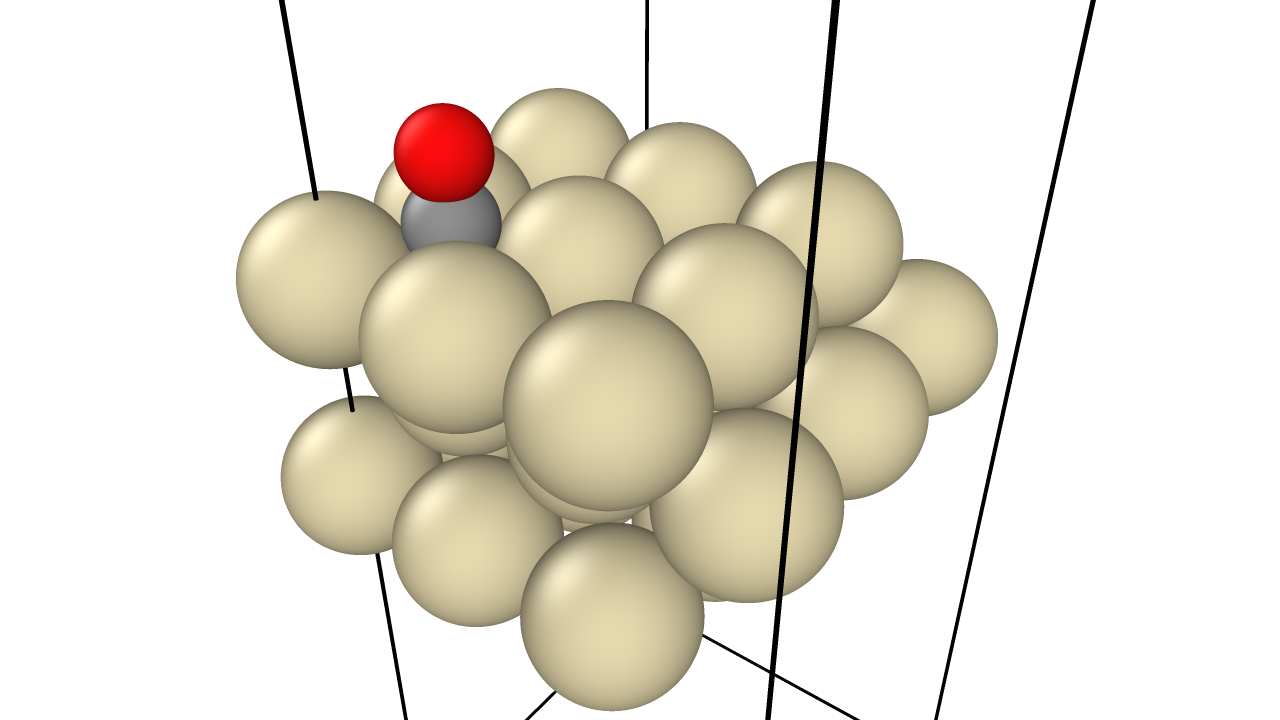
Contribution: Theoretical Modeling of Kinetic Oscillations
Theory ($\Psi_{\text{Theory}}$).
This paper derives a microscopic mechanism based on experimental kinetic data to explain observed kinetic oscillations. It relies heavily on formal analysis, including a Linear Stability Analysis of a simplified model to derive eigenvalues and characterize stationary points (stable nodes, saddle points, and foci) whose appearance and disappearance drive relaxation oscillations. The primary contribution is the mathematical formulation of the surface phase transition.
Motivation: Explaining Periodicity in Surface Reactions
Experimental studies had shown that the catalytic oxidation of Carbon Monoxide (CO) on Platinum (100) surfaces exhibits temporal oscillations and spatial wave patterns at low pressures ($10^{-4}$ Torr). While the individual elementary steps (adsorption, desorption, reaction) were known, the mechanism driving the periodicity was not understood. Prior models relied on indirect evidence; this work aimed to ground the theory in new LEED (Low-Energy Electron Diffraction) observations showing that the surface structure itself transforms periodically between a reconstructed hex phase and a bulk-like 1x1 phase.
Novelty: The Surface Phase Transition Model
The core novelty is the Surface Phase Transition Model. The authors propose that the oscillations are driven by the reversible phase transition of the Pt surface atoms, which is triggered by critical adsorbate coverages:
- State Dependent Kinetics: The
hexand1x1phases have vastly different sticking coefficients for Oxygen (negligible onhex, high on1x1). - Critical Coverage Triggers: The transition depends on whether local CO coverage exceeds a critical threshold ($U_{a,grow}$) or falls below another ($U_{a,crit}$).
- Trapping-Desorption: The model introduces a “trapping” term where CO diffuses from the weakly-binding
hexphase to the strongly-binding1x1patches, creating a feedback loop.
Methodology: Reaction-Diffusion Simulations
As a theoretical paper, the “experiments” were computational simulations and mathematical derivations:
- Linear Stability Analysis: They simplified the 4-variable model to a 3-variable system ($u$, $v$, $a$), then treated the phase fraction $a$ as a slowly varying parameter. This allowed them to perform a 2-variable stability analysis on the $u$-$v$ subsystem, identifying the conditions for oscillations through the appearance and disappearance of stationary points as $a$ varies.
- Hysteresis Simulation: They simulated temperature-programmed variations to match experimental CO adsorption hysteresis loops, fitting the critical coverage parameters ($U_{a,grow} \approx 0.5$).
- Reaction-Diffusion Simulation: They numerically integrated the full set of 4 coupled differential equations over a 1D spatial grid (40 compartments) to reproduce temporal oscillations and propagating wave fronts.
Results: Mechanisms of Spatiotemporal Self-Organization
- Mechanism Validation: The model successfully reproduced the asymmetric oscillation waveform (a slow plateau followed by a steep breakdown) observed in work function and LEED measurements.
- Phase Transition Role: Confirmed that the “slow” step driving the oscillation period is the phase transformation, specifically the requirement for CO to build up to a critical level to nucleate the reactive
1x1phase. - Spatial Self-Organization: The addition of diffusion terms allowed the model to reproduce wave propagation, showing that defects at crystal edges can act as “pacemakers” or triggers for the rest of the surface.
- Chaotic Behavior: Under slightly different conditions (e.g., $T = 470$ K instead of 480 K), the coupled system produces irregular, chaotic work function oscillations. This arises when not every trigger compartment oscillation drives a wave into the bulk because the bulk has not yet recovered from the previous wave front. The authors note that such irregular behavior is the rule rather than the exception in experimental observations.
- Quantitative Limitations: The calculated oscillation periods are at least one order of magnitude shorter than experimental values (1 to 4 min). This discrepancy arises mainly from unrealistically high values of $k_5$ and $k_8$ used to reduce computational time. The model also restricts spatial analysis to a 1D grid, which oversimplifies the true 2D wave patterns seen in experiments. The authors note that microscopic adsorbate-adsorbate interactions and island formation are not included, which would require multi-scale modeling.
Reproducibility Details
To faithfully replicate this study, one must implement the system of four coupled differential equations. The hardware requirements are negligible by modern standards.
Models
The system tracks four state variables:
- $u_a$: CO coverage on the
1x1phase (normalized to local area $a$) - $u_b$: CO coverage on the
hexphase (normalized to local area $b$) - $v_a$: Oxygen coverage on the
1x1phase (normalized to local area $a$) - $a$: Fraction of surface in
1x1phase ($b = 1 - a$)
The Governing Equations:
CO coverage on 1x1 phase: $$ \begin{aligned} \frac{\partial u_a}{\partial t} = k_1 a p_{CO} - k_2 u_a + k_3 a u_b - k_4 u_a v_a / a + k_5 \nabla^2(u_a/a) \end{aligned} $$
CO coverage on hex phase: $$ \begin{aligned} \frac{\partial u_b}{\partial t} = k_1 b p_{CO} - k_6 u_b - k_3 a u_b \end{aligned} $$
Oxygen coverage on 1x1 phase: $$ \begin{aligned} \frac{\partial v_a}{\partial t} = k_7 a p_{O_2} \left[ \left(1 - 2 \frac{u_a}{a} - \frac{5}{3} \frac{v_a}{a}\right)^2 + \alpha \left(1 - \frac{5}{3}\frac{v_a}{a}\right)^2 \right] - k_4 u_a v_a / a \end{aligned} $$
The Phase Transition Logic ($da/dt$):
The growth of the 1x1 phase ($a$) is piecewise, defined by critical coverages:
- If $U_a > U_{a,grow}$ and $\partial u_a/\partial t > 0$: island growth with $\partial a/\partial t = (1/U_{a,grow}) \cdot \partial u_a/\partial t$
- If $c = U_a/U_{a,crit} + V_a/V_{a,crit} < 1$: decay to hex with $\partial a/\partial t = -k_8 a c$
- Otherwise: $\partial a/\partial t = 0$
Algorithms
- Time Integration: Runge-Kutta-Merson routine.
- Spatial Integration: Crank-Nicholson algorithm for the diffusion term.
- Time Step: $\Delta t = 10^{-4}$ s.
- Spatial Grid: 1D array of 40 compartments, total length 0.4 cm (each compartment 0.01 cm).
- Boundary Conditions: Closed ends (no flux). Defects simulated by setting $\alpha$ higher in the first 3 “edge” compartments.
Data
Replication requires the specific rate constants. Note: $k_3$ and $\alpha$ are fitting parameters.
| Parameter | Symbol | Value (at 480 K) | Description |
|---|---|---|---|
| CO Stick | $k_1$ | $2.94 \times 10^5$ ML/s/Torr | Pre-exponential factor |
| CO Desorp (1x1) | $k_2$ | $1.5$ s$^{-1}$ ($U_a = 0.5$) | $E_a = 37.3$ (low cov), $33.5$ kcal/mol (high cov) |
| Trapping | $k_3$ | $50 \pm 30$ s$^{-1}$ | Hex to 1x1 diffusion |
| Reaction | $k_4$ | $10^3 - 10^5$ ML$^{-1}$s$^{-1}$ | Langmuir-Hinshelwood |
| Diffusion | $k_5$ | $4 \times 10^{-4}$ cm$^2$/s | CO surface diffusion (elevated for computational speed; realistic: $10^{-7}$ to $10^{-5}$) |
| CO Desorp (hex) | $k_6$ | $11$ s$^{-1}$ | $E_a = 27.5$ kcal/mol |
| O2 Adsorption | $k_7$ | $5.6 \times 10^5$ ML/s/Torr | Only on 1x1 phase |
| Phase Trans | $k_8$ | $0.4 - 2.0$ s$^{-1}$ | Relaxation constant |
| Defect Coeff | $\alpha$ | $0.1 - 0.5$ | Fitting param for defects |
| Crit Cov (Grow) | $U_{a,grow}$ | $0.5 \pm 0.1$ | Trigger for hex to 1x1 |
| Crit Cov (Decay) | $U_{a,crit}$ | $0.32$ | Trigger for 1x1 to hex (CO) |
| Crit O Cov | $V_{a,crit}$ | $0.4$ | Trigger for 1x1 to hex (O) |
Evaluation
The model was evaluated by comparing the simulated temporal oscillations and spatial wave patterns against experimental work function measurements and LEED observations.
Hardware
The hardware requirements are negligible by modern standards. The original simulations were likely performed on a mainframe or minicomputer of the era. Today, they can be run on any standard personal computer.
Paper Information
Citation: Imbihl, R., Cox, M. P., Ertl, G., Müller, H., & Brenig, W. (1985). Kinetic oscillations in the catalytic CO oxidation on Pt(100): Theory. The Journal of Chemical Physics, 83(4), 1578-1587. https://doi.org/10.1063/1.449834
Publication: The Journal of Chemical Physics 1985
Related Work: See also Oscillatory CO Oxidation on Pt(110) for the same catalytic system on a different crystal face, demonstrating that surface phase transitions drive oscillatory behavior across multiple platinum surfaces.
@article{imbihl1985kinetic,
  title={Kinetic oscillations in the catalytic CO oxidation on Pt(100): Theory},
  author={Imbihl, R and Cox, MP and Ertl, G and M{\"u}ller, H and Brenig, W},
  journal={The Journal of Chemical Physics},
  volume={83},
  number={4},
  pages={1578--1587},
  year={1985},
  publisher={American Institute of Physics}
}