Abstract
Social media research is often siloed by platform, with tools built specifically for Twitter’s flat structure or Reddit’s tree structure. This fragmentation makes cross-platform analysis difficult. In this work, I introduce PyConversations, an open-source Python package that normalizes data from Twitter, Facebook, Reddit, and 4chan into a single, platform-agnostic data model. (Note: the repository is archived and no longer actively maintained.)
Leveraging this tool, I processed over 308 million posts to analyze the structural “shape” of online conversations. I then evaluated the efficacy of domain-adaptive pre-training (DAPT) for Transformer-based language models, finding that training on a toxic domain (4chan) boosts hate-speech detection by over 5 F1.
The Engineering Problem: Data Normalization
Social media platforms impose different structural constraints on discourse, making it difficult to feed heterogeneous data into a single ML pipeline:
- Twitter: Technically allows infinite depth, but functionally operates as a flat stream or shallow tree.
- Facebook: Enforces a hard limit of two depth levels (comments and replies), resulting in “short and fat” conversation trees.
- Reddit & 4chan: Allow for deep, branching tree structures.
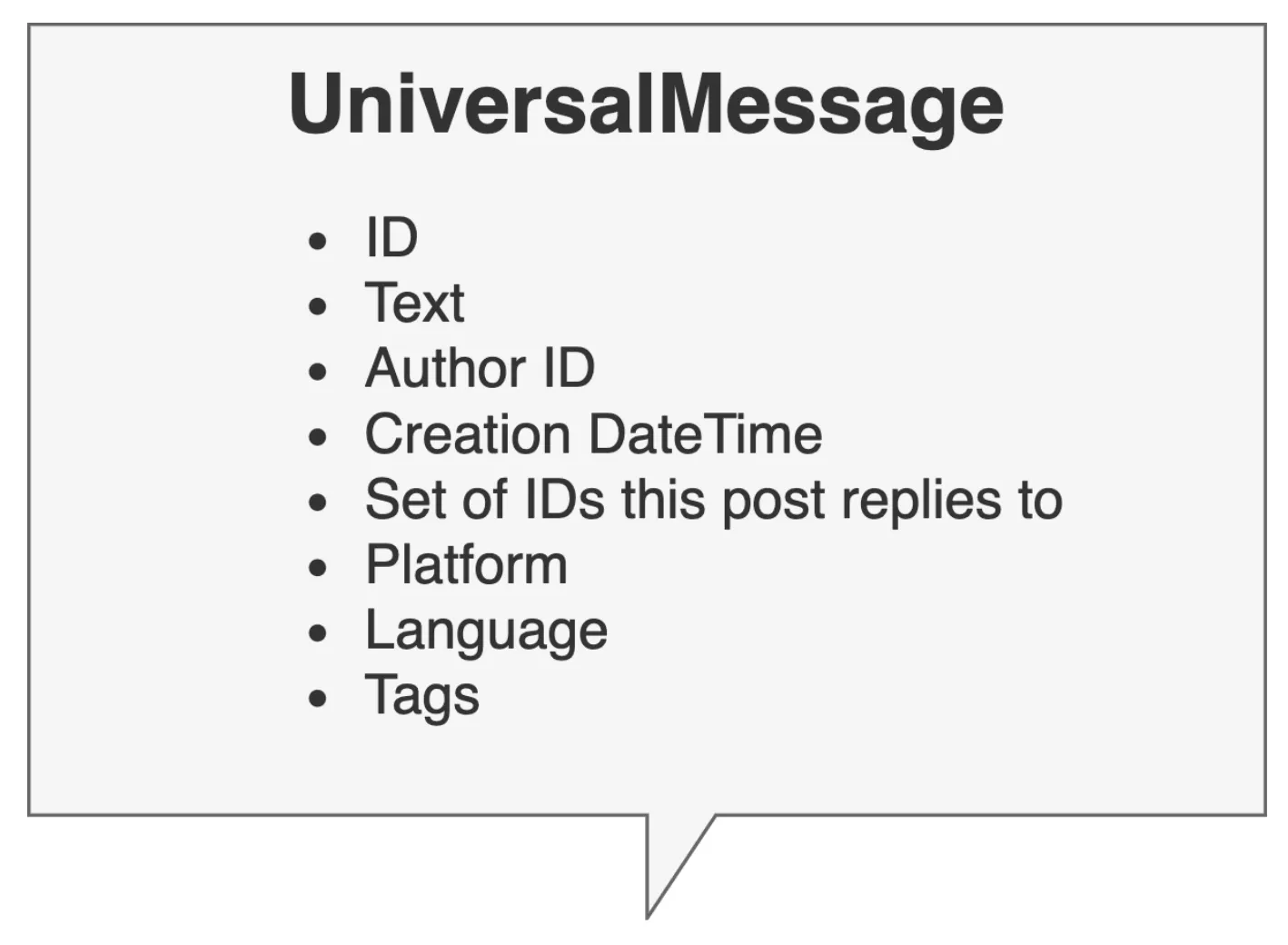
To solve this, I designed a Universal Message Schema and the PyConversations library. This system ingests raw dumps from these disparate sources and maps them to a unified Directed Acyclic Graph (DAG) format, preserving the parent-child relationships regardless of the source platform’s constraints.
Key Contributions
- PyConversations Library: An open-source package for robust conversational analysis, featuring graph-based traversing and filtering.
- Massive Dataset Analysis: Processed a collection of 308 million posts and 15.8 million conversations, creating one of the largest comparative cross-platform analyses at the time of thesis submission.
- Structural Insights: Quantified how UI constraints shape human behavior. For instance, Facebook’s depth limit forces users to “bunch” comments, creating uniquely wide conversation trees compared to Reddit’s deep, narrow threads.
- Domain Adaptation Experiments: Continued-pretrained RoBERTa on platform-specific slices (e.g., the 4chan-adapted
RoBERTa-4chan), demonstrating that exposing models to toxic domains improved hate-speech detection F1 by over 5 points.
Structural Analysis Findings
By treating conversations as graphs, I uncovered distinct topological signatures for each platform:
The “Shape” of Discourse
I measured the width (max posts at any depth) and depth (max distance from root) of conversation trees.
- Facebook exhibited a “short and fat” topology due to its 2-level nesting limit.
- 4chan threads were surprisingly shallow despite having no depth limits. This suggests that the platform’s ephemerality (threads are deleted quickly) and the “bump limit” mechanic discourage long-term dialogue, though data scraping limitations on this transient platform also contribute to this topology.
- Reddit maintained the most robust tree structures, with “good faith” communities like r/ChangeMyView showing distinct patterns of sustained engagement.
Information Density
I analyzed Innovation Rate, a measure of how quickly a text introduces new vocabulary. Twitter and Facebook posts regress to negative rates; Reddit and 4chan posts sit well above zero.
Representation Learning & Domain Adaptation
I experimented with “Warm-Start” tuning: taking a standard RoBERTa model and pre-training it further on platform-specific data before fine-tuning on downstream tasks (TweetEval).
- Limited gains on most general tasks: Domain-adaptive pre-training added little on sentiment and emotion (from well under 1 up to a few F1 points), with irony detection the exception (+5.6 to +5.9 F1). Base RoBERTa already covers most of the signal for general NLP tasks.
- The Toxic Exception: The notable exception was Hate Speech Detection. The 4chan-adapted model (
RoBERTa-4chan) was the strongest here, outperforming the baseline by over 5 F1. This highlights that for specialized, out-of-distribution language (like toxic slang), domain adaptation remains valuable.
Citation
@thesis{heidenreich2021look,
  title={Look, Don't Tweet: Representation Learning and Social Media},
  author={Hunter Heidenreich},
  year={2021},
  school={Drexel University},
  type={Undergraduate Senior Thesis}
}
Related Work
For related work on how social media content surfaces in digital journalism, including a dataset of embedded tweets across 273,899 news articles, see NewsTweet Dataset: Social Media in Digital Journalism.