Generative Modeling
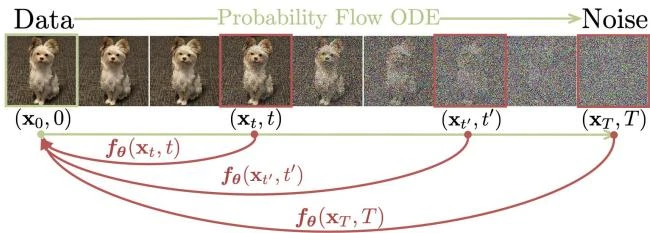
Diagram showing consistency models mapping points on a PF ODE trajectory to the same origin

Consistency Models: Fast One-Step Diffusion Generation

This paper introduces consistency models, a new family of generative models that map any point on a Probability Flow ODE trajectory to its origin. They support fast one-step generation by design, while allowing multi-step sampling for improved quality and zero-shot editing tasks like inpainting and colorization.
Generative Modeling
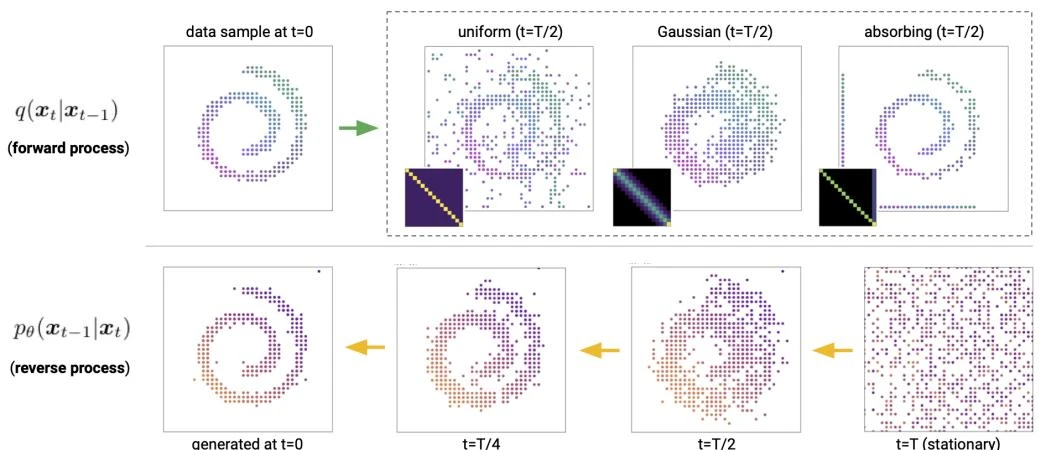
D3PM forward and reverse processes on a quantized swiss roll with uniform, Gaussian, and absorbing transition matrices

D3PM: Discrete Denoising Diffusion Probabilistic Models

This paper introduces Discrete Denoising Diffusion Probabilistic Models (D3PMs), which generalize diffusion to discrete state-spaces using structured Markov transition matrices. D3PMs include uniform, absorbing-state, and discretized Gaussian corruption processes, drawing a connection between diffusion and masked language models.

Generative Modeling
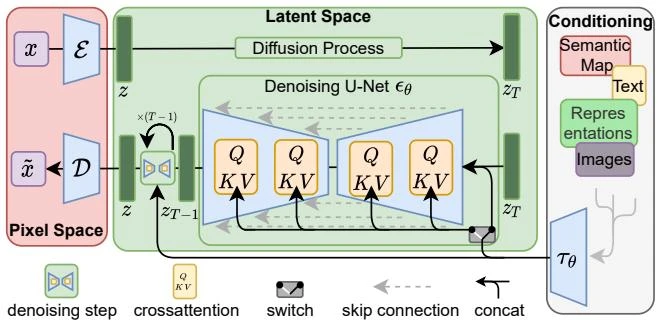
LDM architecture diagram showing conditioning via concatenation and cross-attention

Latent Diffusion Models for High-Res Image Synthesis

This paper introduces Latent Diffusion Models (LDMs), which apply denoising diffusion in the latent space of pretrained autoencoders. By separating perceptual compression from generative learning and adding cross-attention conditioning, LDMs achieve FID 1.50 on Places inpainting and FID 3.60 on ImageNet class-conditional synthesis, with competitive text-to-image generation, at a fraction of the compute cost of pixel-space diffusion.

Generative Modeling
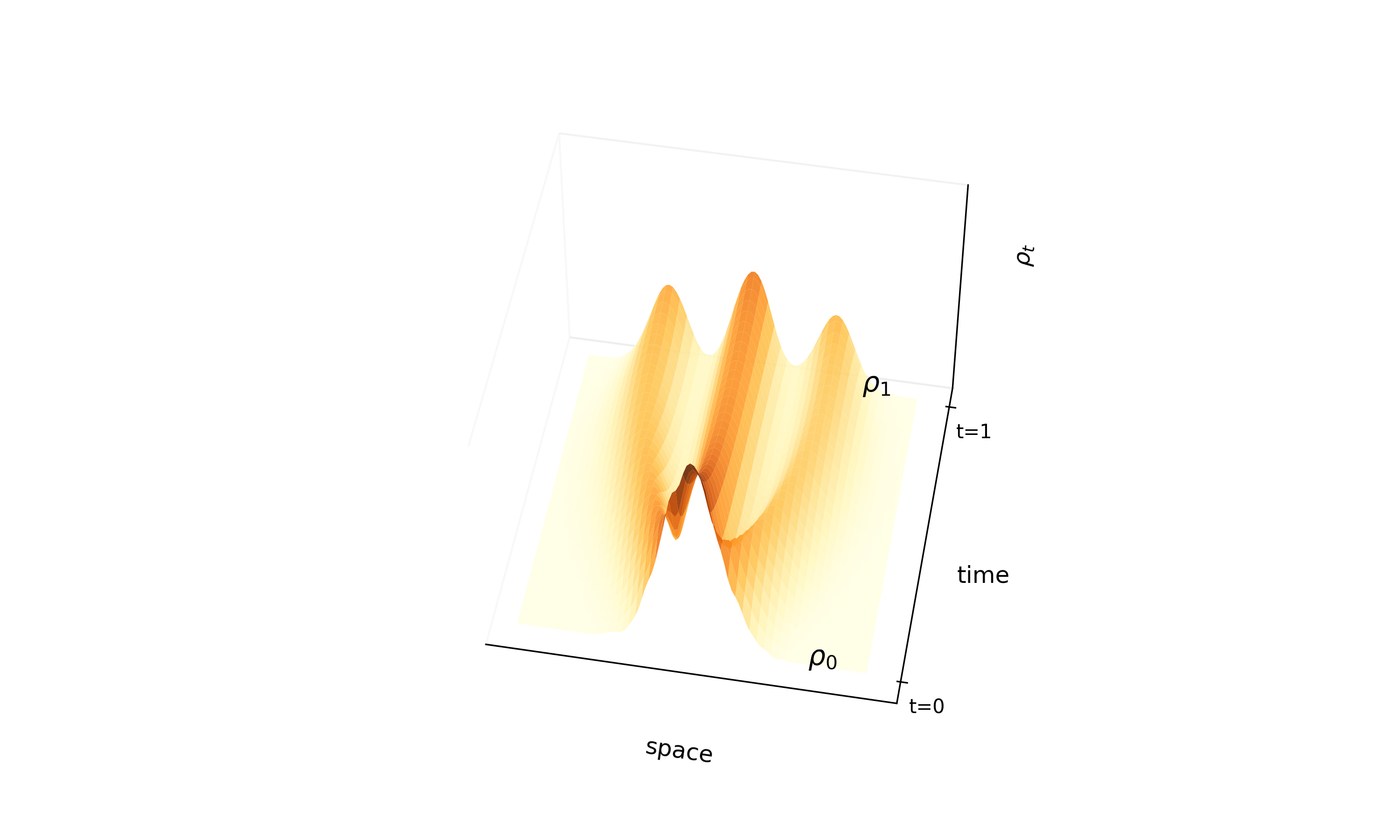
Visualization of probability density flow from initial distribution ρ₀ to target distribution ρ₁ over time through space

Building Normalizing Flows with Stochastic Interpolants

Proposes ‘InterFlow’, a method to learn continuous normalizing flows between arbitrary densities using stochastic interpolants. It avoids ODE backpropagation by minimizing a quadratic objective on the velocity field, enabling scalable ODE-based generation. On CIFAR-10, NLL matches ScoreSDE (2.99 bits per dim) with simulation-free training, though FID (10.27) trails dedicated image models (ScoreSDE: 2.92); the primary strength is tractable likelihood with efficient training cost.

Generative Modeling
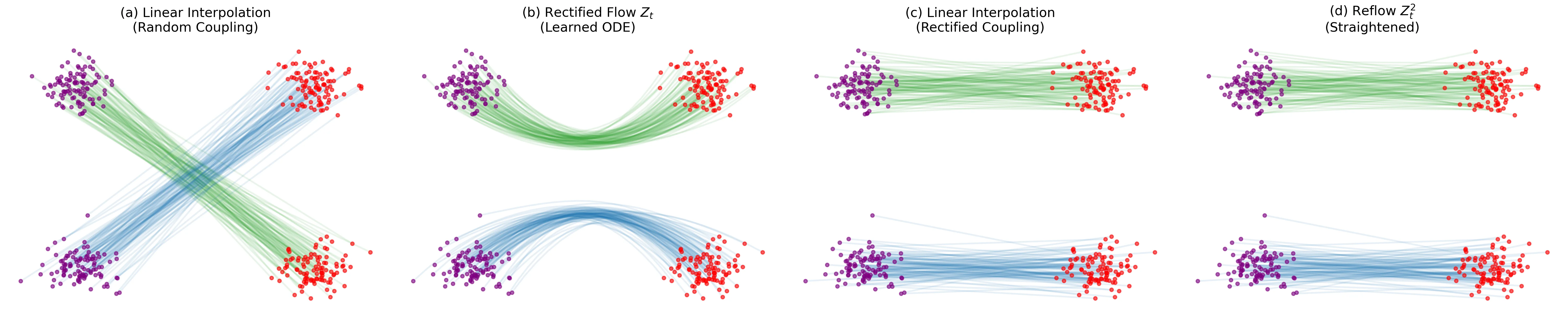
Visualization showing linear interpolation, learned ODE trajectories, and the reflow straightening process for rectified flow

Rectified Flow: Learning to Generate and Transfer Data

Introduces ‘Rectified Flow,’ a method to transport distributions via ODEs with straight paths. Uses a ‘reflow’ procedure to iteratively straighten trajectories, enabling high-quality 1-step generation with optional lightweight distillation.

Generative Modeling
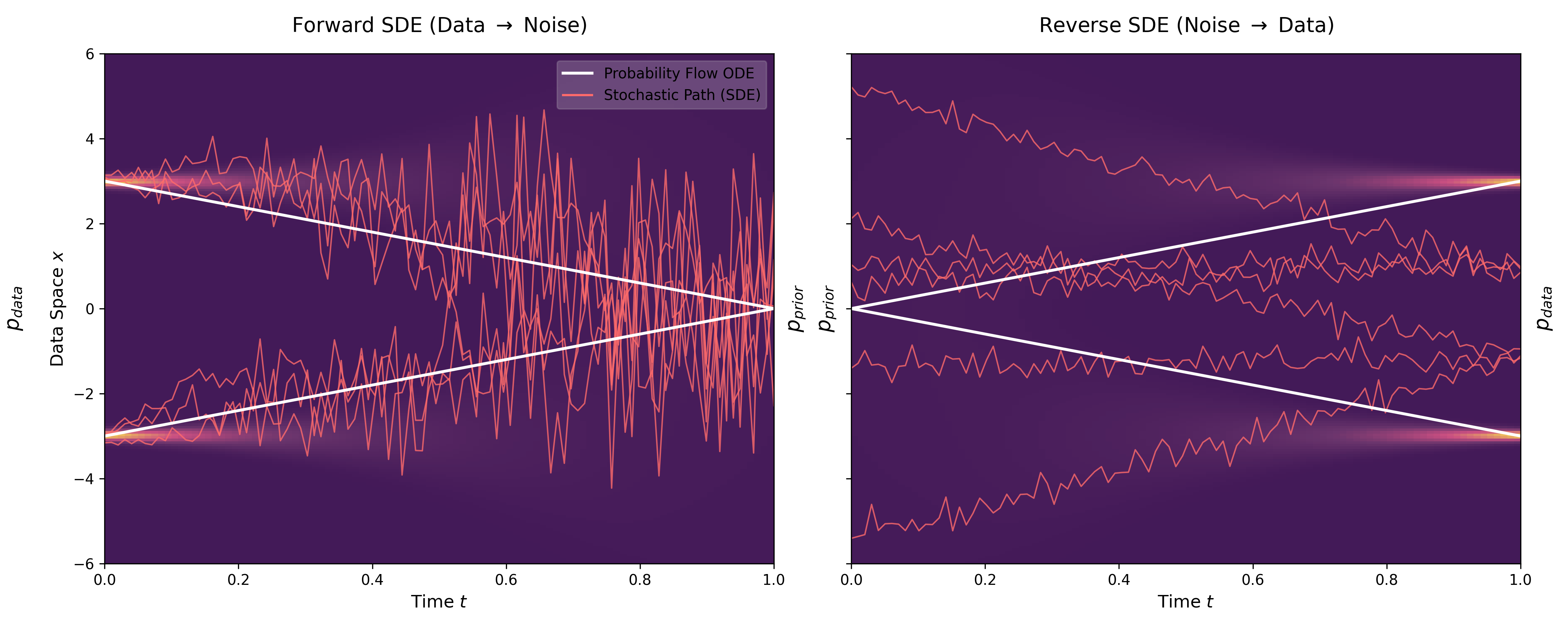
Forward and Reverse SDE trajectories showing the diffusion process from data to noise and back

Score-Based Generative Modeling with SDEs (Song 2021)

This paper unifies previous score-based methods (SMLD and DDPM) under a continuous-time SDE framework. It introduces Predictor-Corrector samplers for improved generation and Probability Flow ODEs for near-exact likelihood computation, setting new records on CIFAR-10.

Computational Chemistry
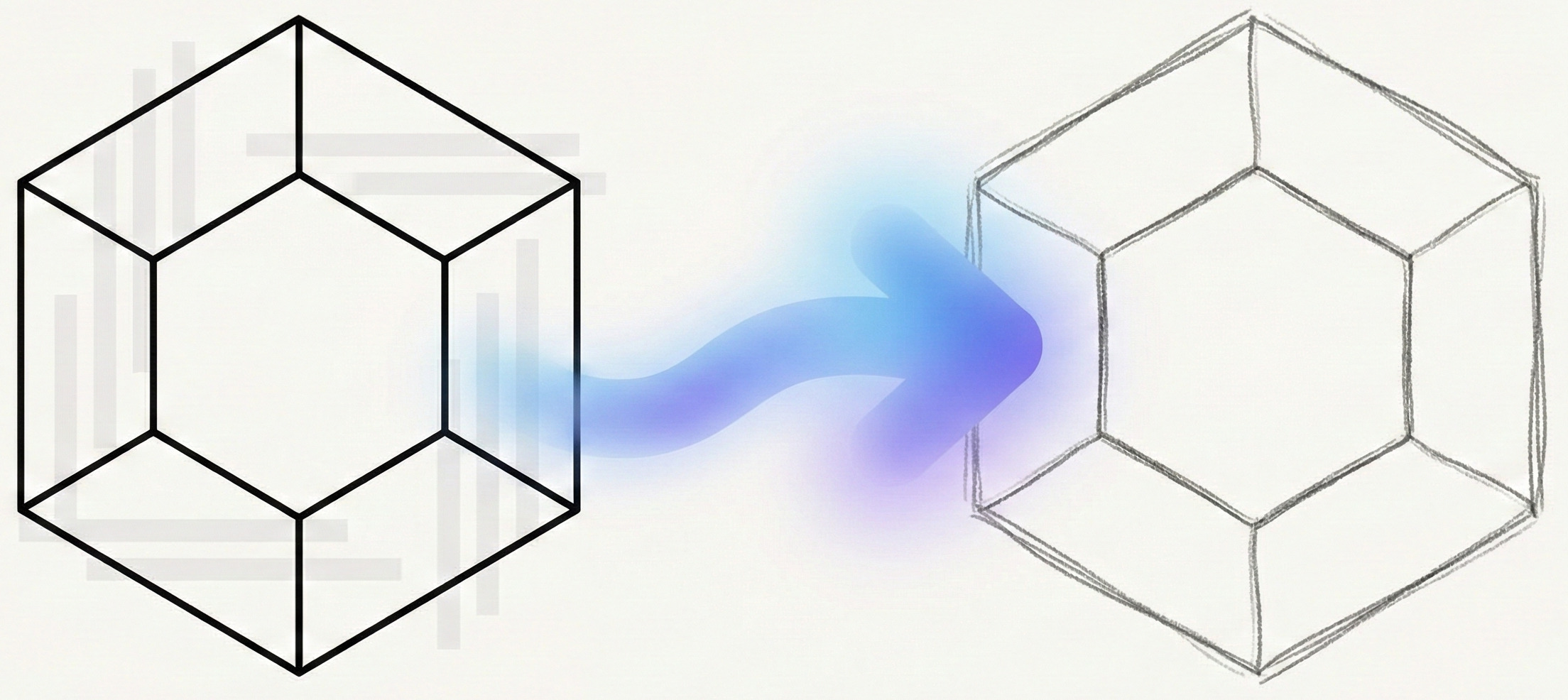
Overview of the OCSAug pipeline showing DDPM training, masked RePaint augmentation, and OCSR fine-tuning phases.

OCSAug: Diffusion-Based Augmentation for Hand-Drawn OCSR

OCSAug uses Denoising Diffusion Probabilistic Models (DDPM) and the RePaint algorithm with custom masking to generate synthetic hand-drawn chemical structure images, improving OCSR performance by 1.918-3.820x on the DECIMER benchmark.

Computational Chemistry
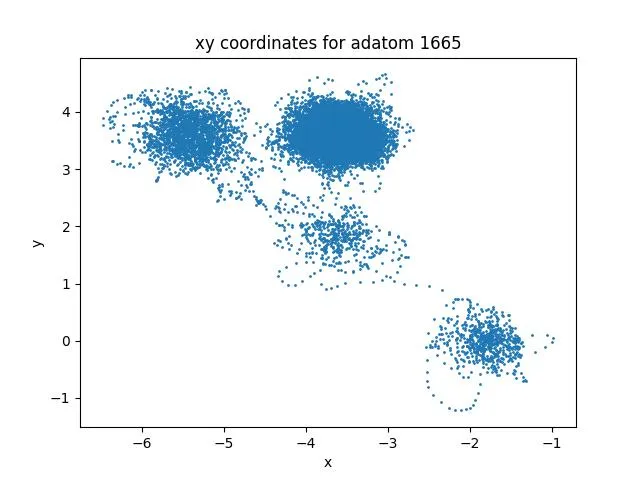
Copper adatom trajectory on Cu(100) surface

Copper Adatom Diffusion on Cu(100): LAMMPS Simulation

Watch copper atoms move across a crystal surface in this molecular dynamics simulation. This video demonstrates surface diffusion mechanisms important for understanding catalysis and crystal growth processes.

Computational Chemistry
Adatom surface diffusion trajectory on FCC metal surface

Platinum Adatom Diffusion on Pt(100): LAMMPS Simulation

Visualize platinum atom diffusion on crystal surfaces in this LAMMPS molecular dynamics simulation. Understand surface mobility mechanisms crucial for catalysis and materials design.

Scientific Computing
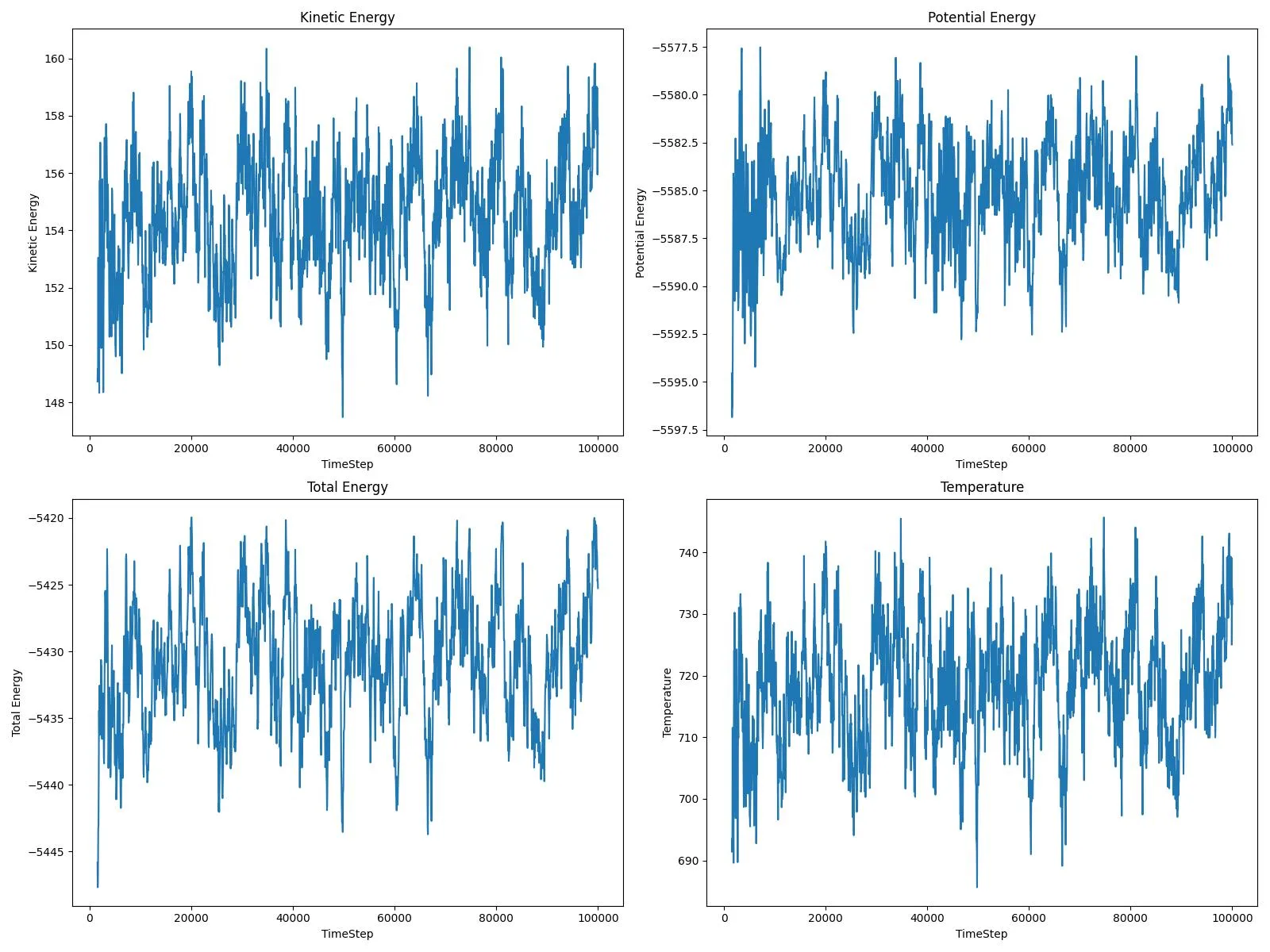
Energy conservation plot showing kinetic, potential, and total energy oscillations for a copper adatom diffusion simulation

Automated Adatom Diffusion Workflow

A complete input-to-analysis workflow for simulating adatom diffusion on FCC metal surfaces using LAMMPS and EAM potentials, providing comparative datasets for copper and platinum that demonstrate how atomic mass and bonding strength affect surface dynamics, with automated Python analysis generating publication-ready visualizations.