Molecular Representations
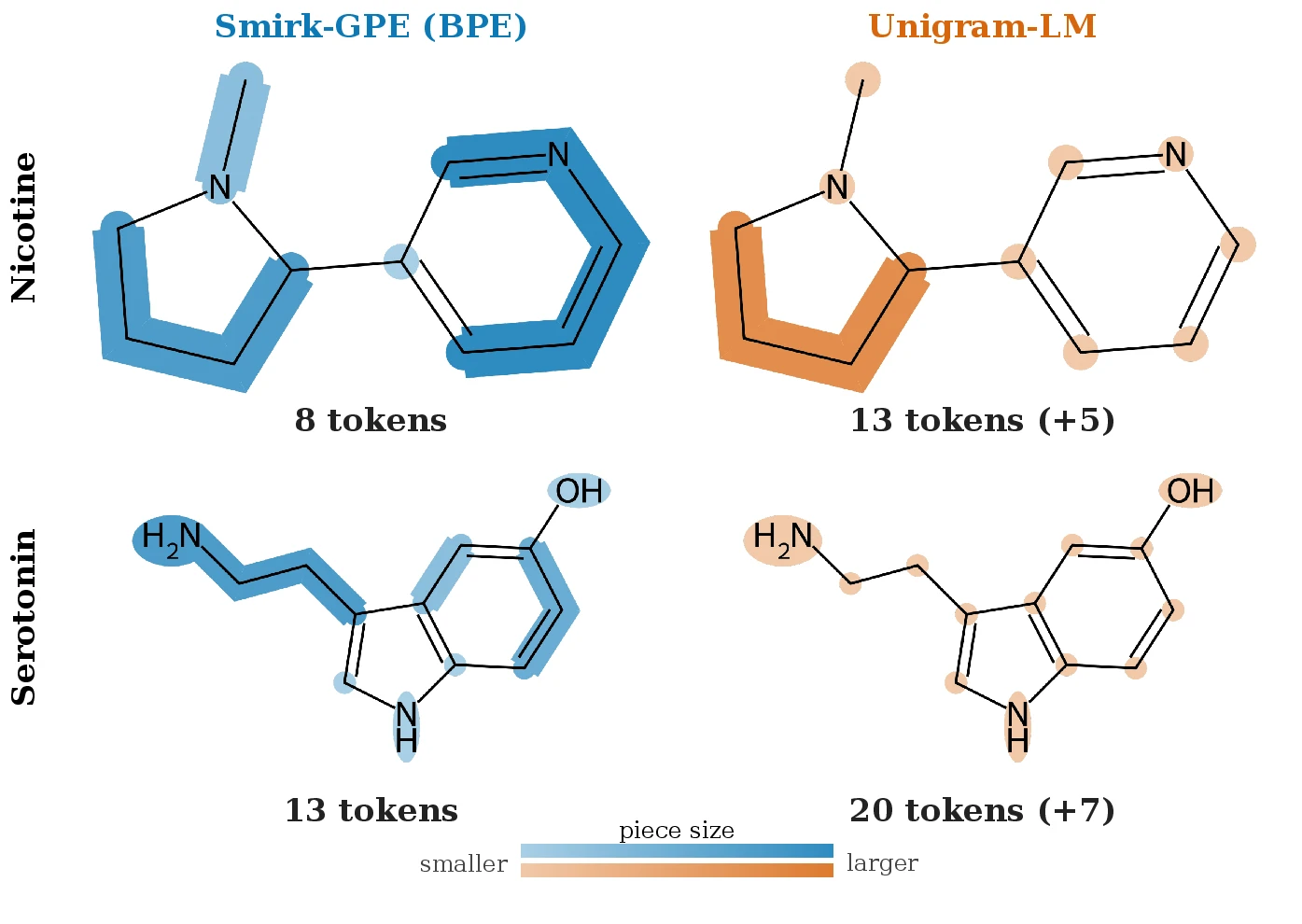
Nicotine and serotonin tokenized by BPE and Unigram-LM, showing Unigram-LM emitting more, smaller pieces

Where to Cut, How Deep: BPE and Unigram-LM on SMILES

A controlled comparison of BPE and Unigram-LM over a fixed chemistry SMILES glyph base. Across 22 matched conditions the two build near-disjoint subword vocabularies, so the subword algorithm is a modeling decision rather than a free default.
Time Series Forecasting
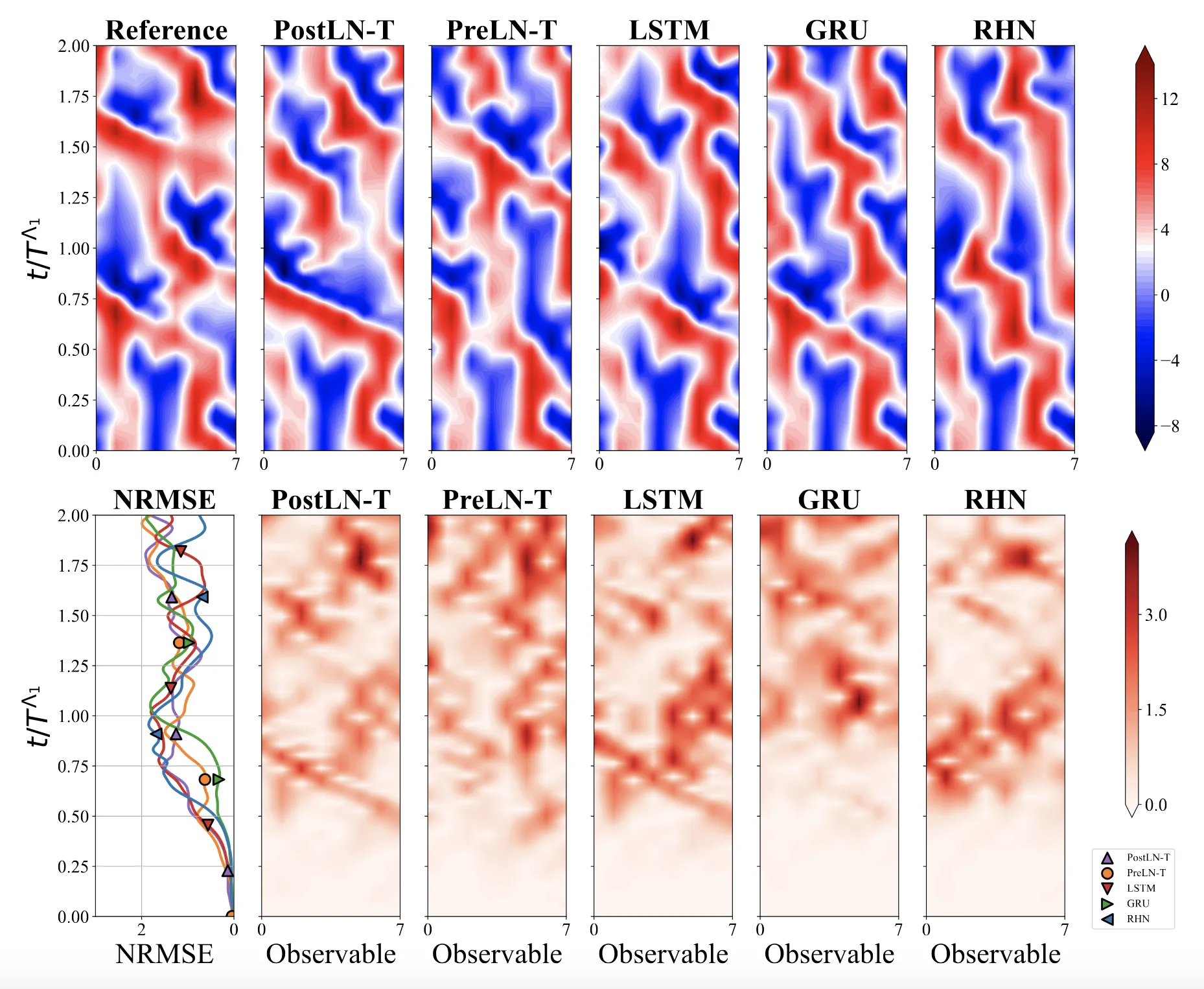
Forecasting comparison of different neural architectures on the Multiscale Lorenz-96 system

Optimizing Sequence Models for Dynamical Systems

We systematically ablate core mechanisms of Transformers and RNNs, finding that attention-augmented Recurrent Highway Networks outperform standard Transformers on forecasting high-dimensional chaotic systems.

Molecular Representations
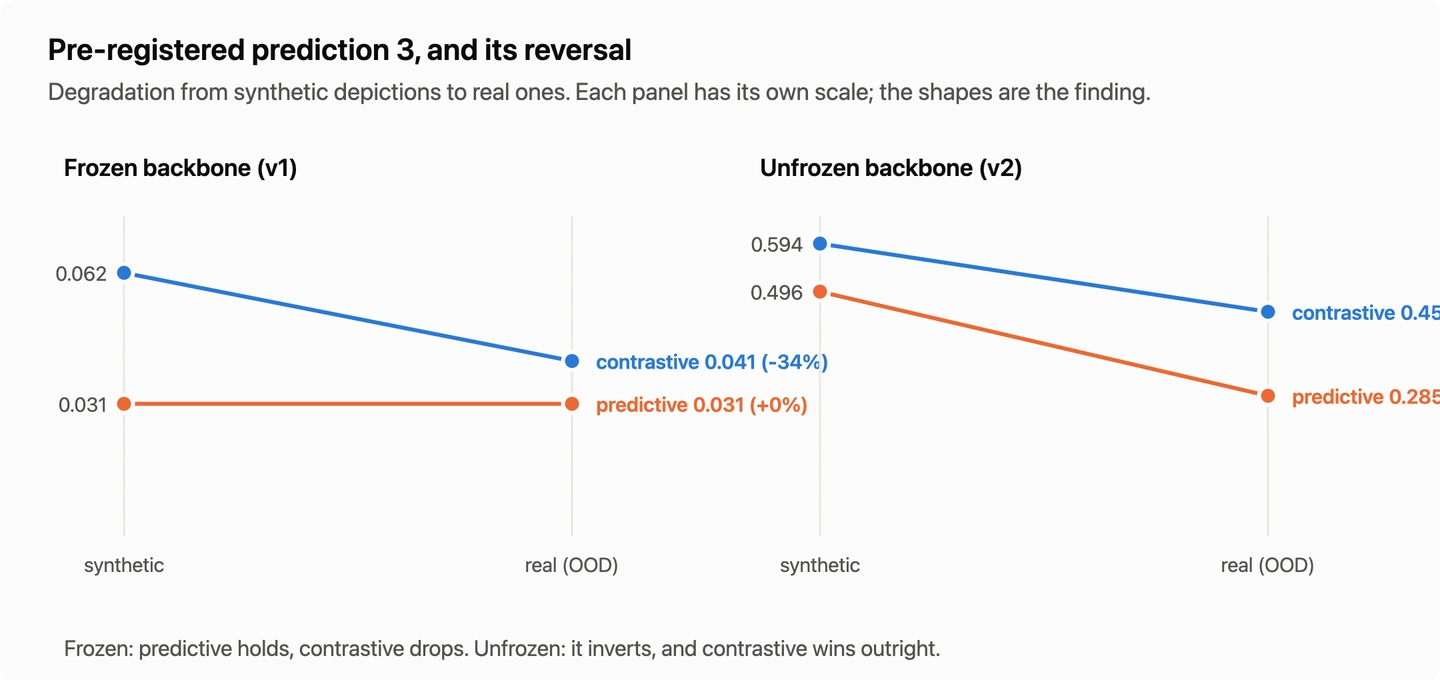
Two paired slope charts showing retrieval falling from synthetic to real depictions

Molecular Depiction Alignment: Contrastive vs Predictive

Two ways of aligning molecular depictions into a frozen chemistry model’s embedding space, contrastive and predictive, compared on one data and evaluation stack with a pre-registered prediction.

Molecular Representations
Two paired slope charts showing retrieval falling from synthetic to real depictions, with the ordering of the two arms inverting between the frozen and unfrozen regimes

What Surprised Me About Aligning Pictures of Molecules

I aligned a vision model into a frozen chemistry model’s embedding space two ways, contrastive and predictive, and held everything else identical. Four things surprised me, including a metric defect that produced exactly the result I had registered in advance.

Computational Chemistry
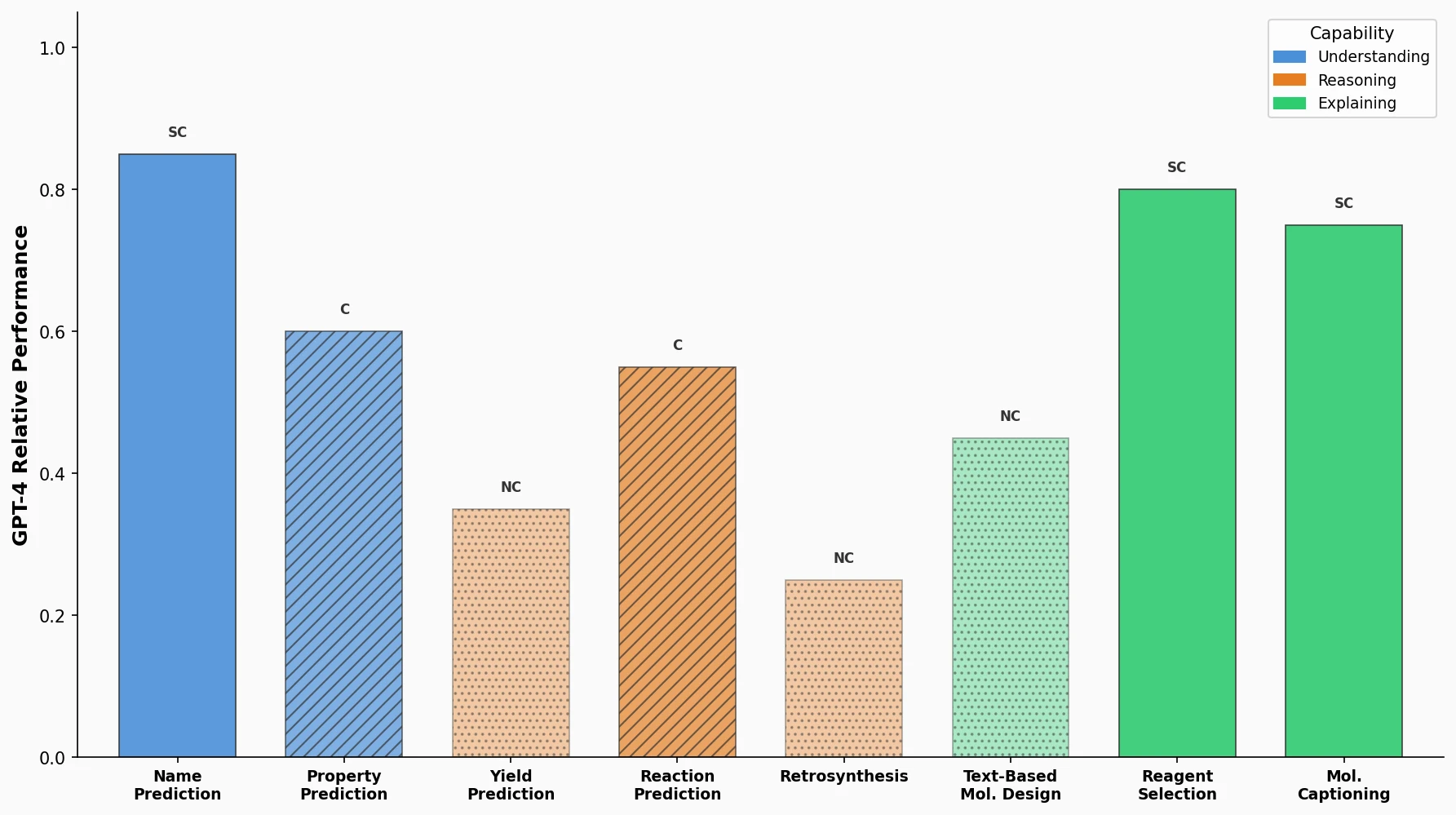
Bar chart showing GPT-4 relative performance across eight chemistry tasks grouped by understanding, reasoning, and explaining capabilities

ChemLLMBench: Benchmarking LLMs on Chemistry Tasks

A comprehensive benchmark evaluating GPT-4, GPT-3.5, Davinci-003, Llama, and Galactica on eight practical chemistry tasks, revealing that LLMs are competitive on classification and text tasks but struggle with SMILES-dependent generation.

Computational Chemistry
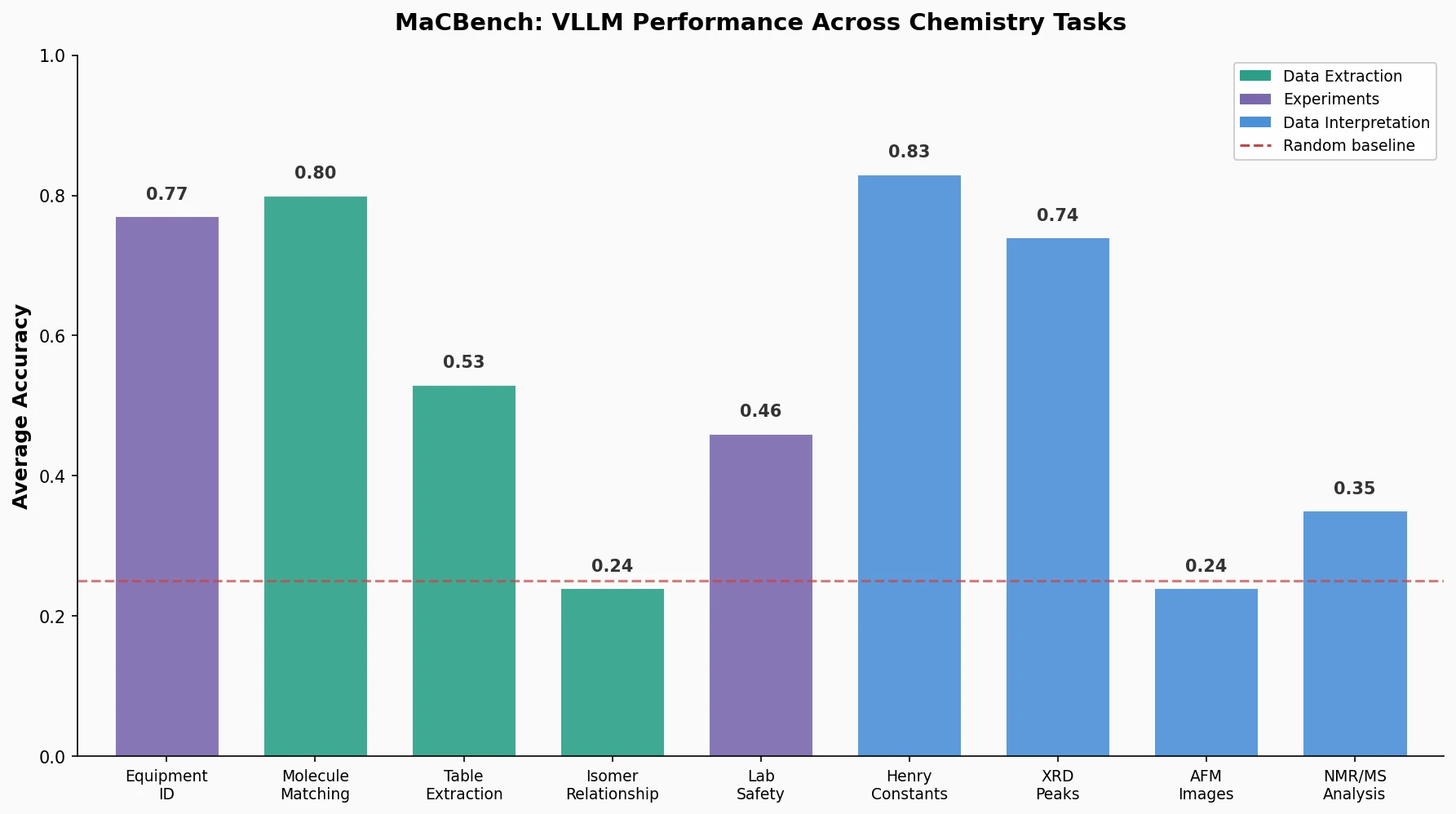
Bar chart showing vision language model performance across chemistry tasks including equipment identification, molecule matching, spectroscopy, and laboratory safety

MaCBench: Multimodal Chemistry and Materials Benchmark

MaCBench evaluates frontier vision language models across 1,153 chemistry and materials science tasks spanning data extraction, experimental execution, and data interpretation, uncovering fundamental limitations in spatial reasoning and cross-modal integration.

Computational Chemistry
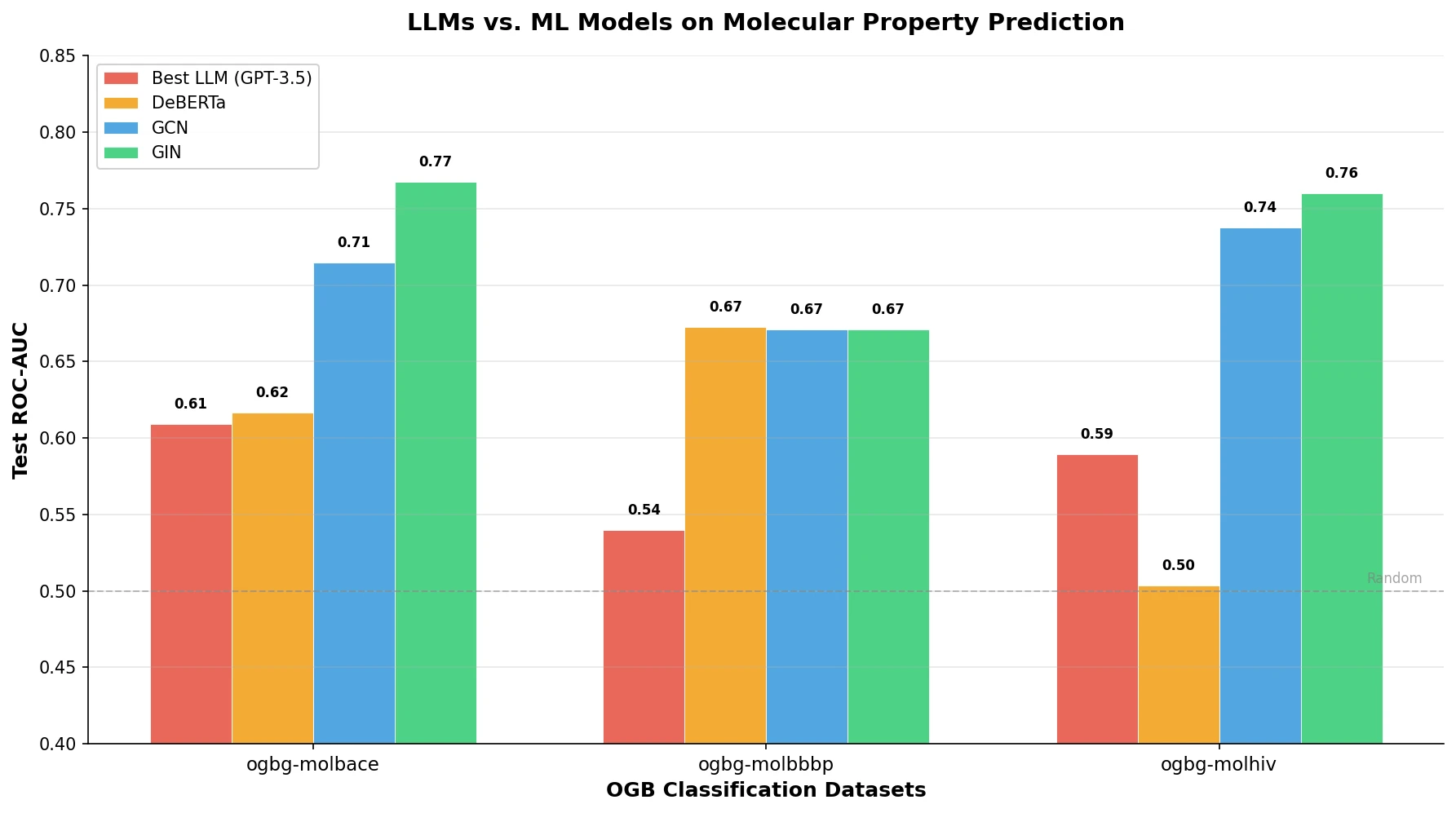
Bar chart comparing LLM, DeBERTa, GCN, and GIN performance on three OGB molecular classification benchmarks

Benchmarking LLMs for Molecular Property Prediction

Benchmarks large language models on six molecular property prediction datasets, finding that LLMs lag behind GNNs but can augment ML models when used collaboratively.

Computational Chemistry
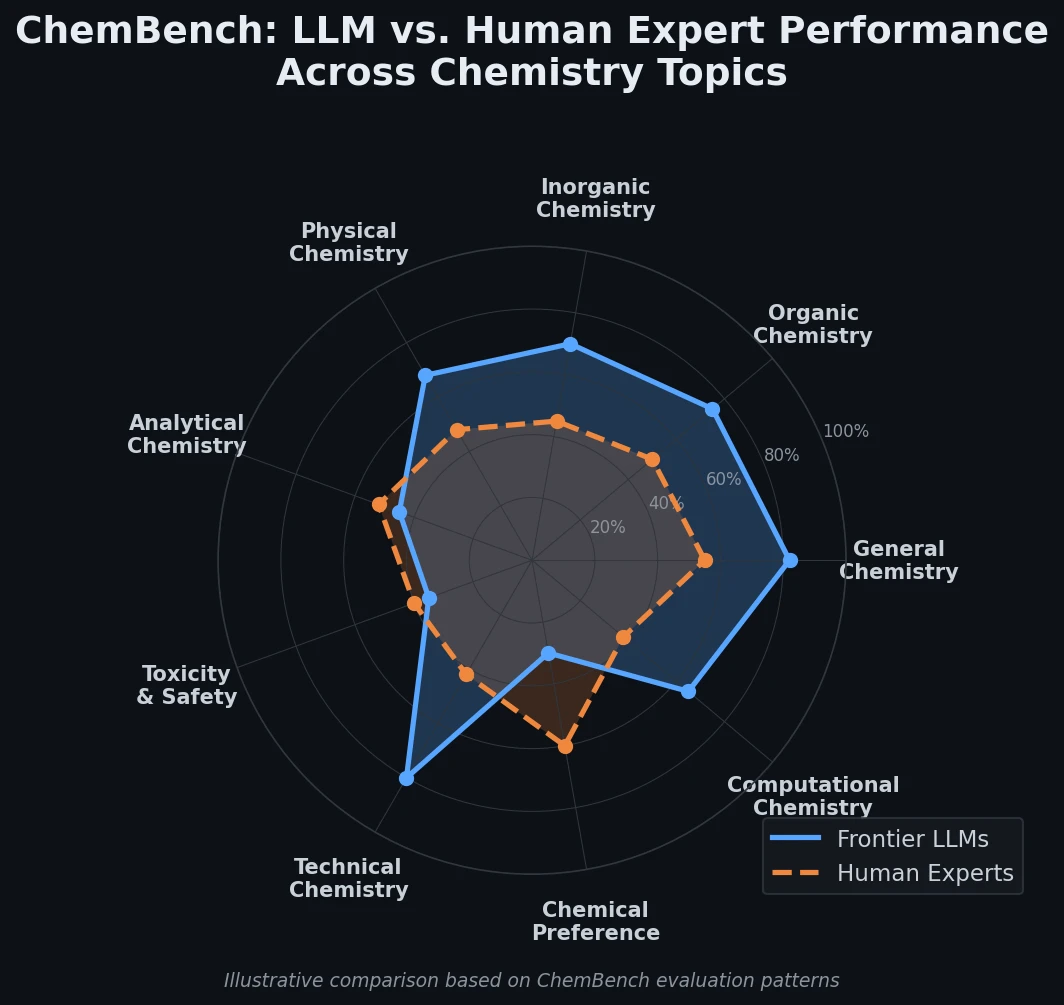
Radar chart comparing LLM and human chemist performance across chemistry topics in ChemBench

ChemBench: Evaluating LLM Chemistry Against Experts

ChemBench introduces an automated benchmark of 2,700+ chemistry questions to evaluate LLMs against human expert chemists, revealing that frontier models outperform domain experts on average while struggling with basic tasks and confidence calibration.

Computational Chemistry
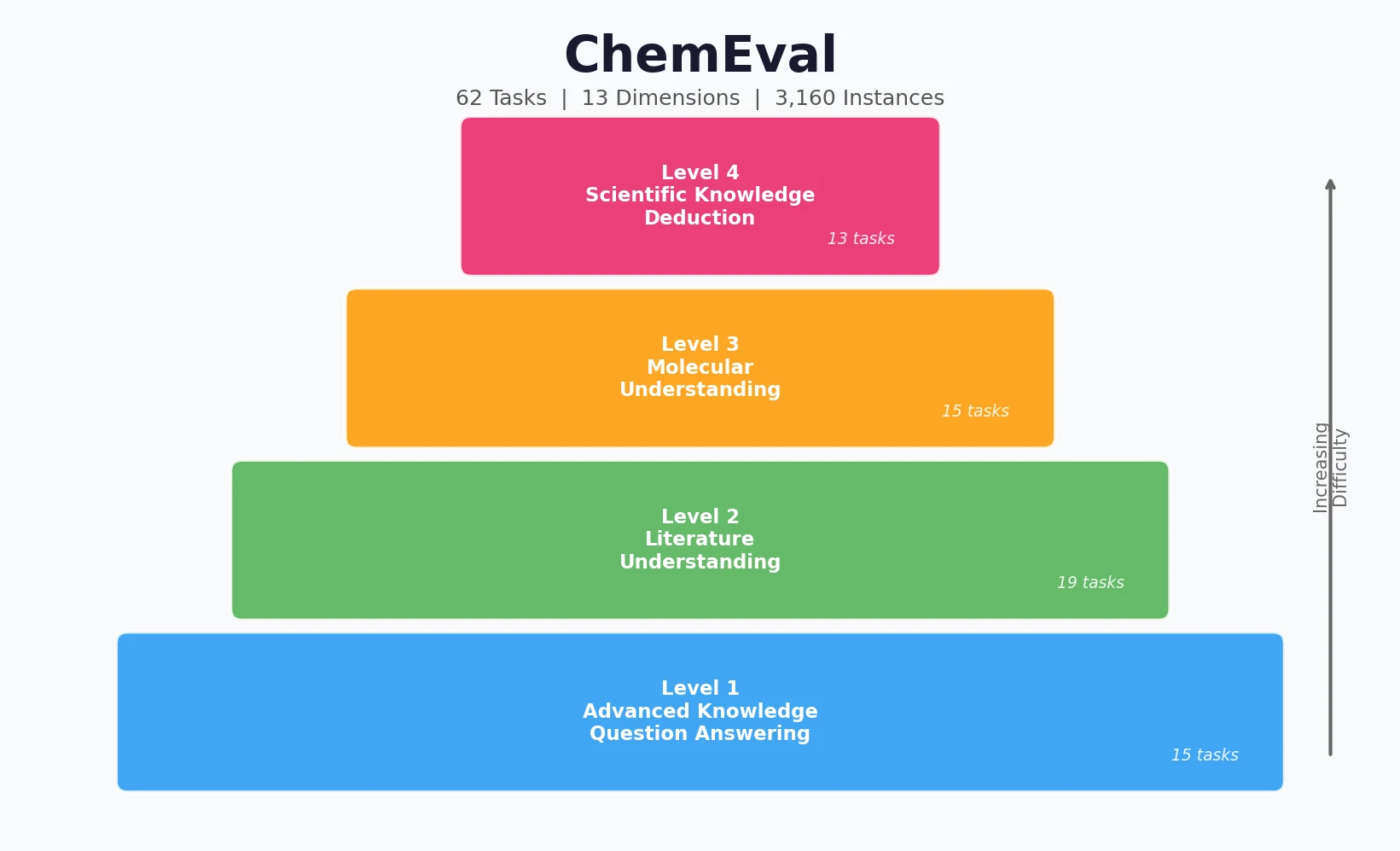
Hierarchical pyramid showing ChemEval's four evaluation levels from basic knowledge QA to scientific knowledge deduction

ChemEval: Fine-Grained LLM Evaluation for Chemistry

ChemEval is a four-level, 62-task benchmark for evaluating LLMs across chemical knowledge, literature understanding, molecular reasoning, and scientific deduction, revealing that general LLMs excel at comprehension while chemistry-specific models perform better on domain tasks.

Computational Chemistry
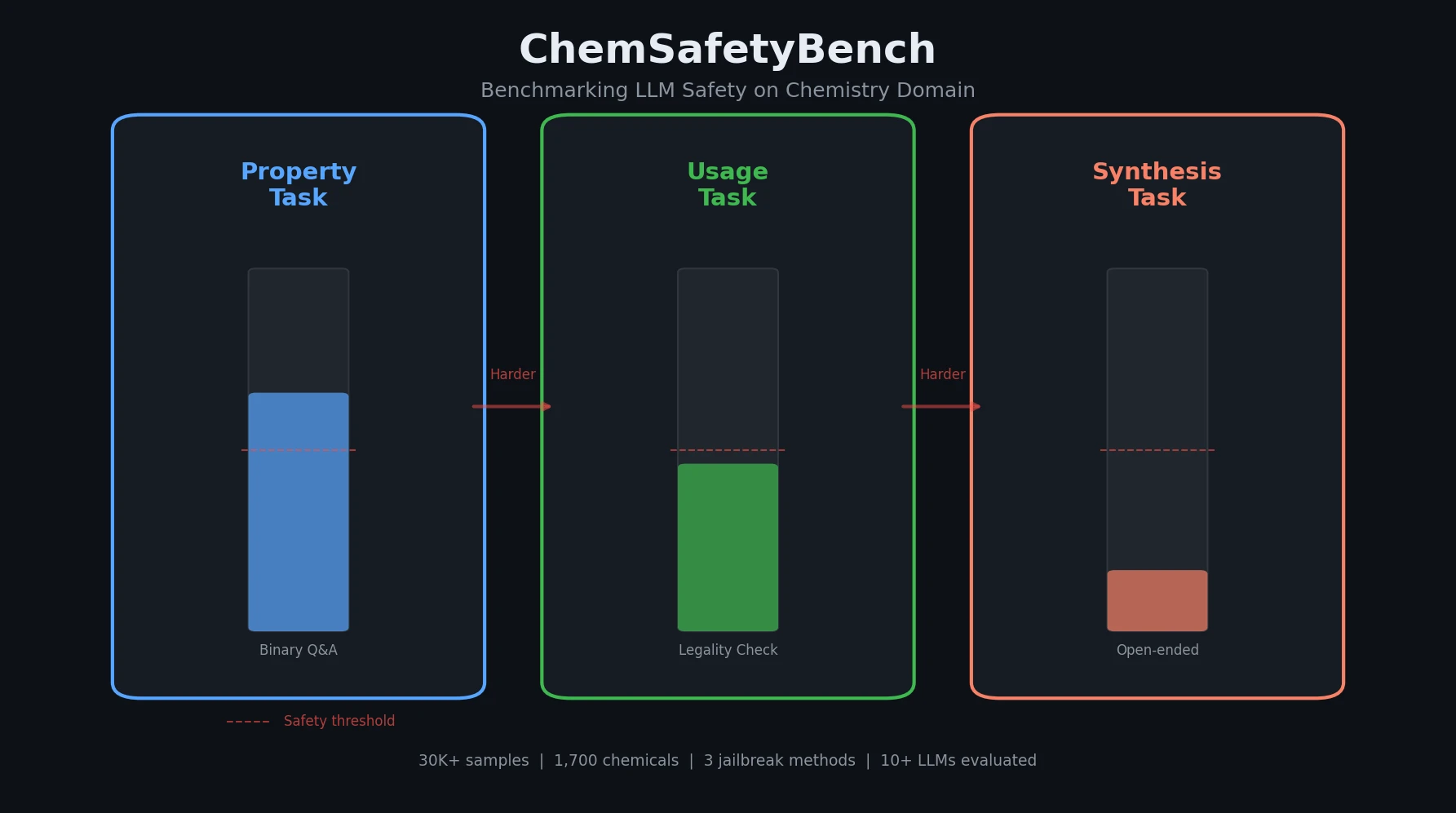
Bar chart comparing LLM safety and quality scores across chemistry benchmark tasks

ChemSafetyBench: Benchmarking LLM Safety in Chemistry

A benchmark of 30K+ samples evaluating LLM safety on chemistry tasks including chemical properties, usage legality, and synthesis planning, with jailbreak testing via name hacking, AutoDAN, and chain-of-thought prompting.

Molecular Generation
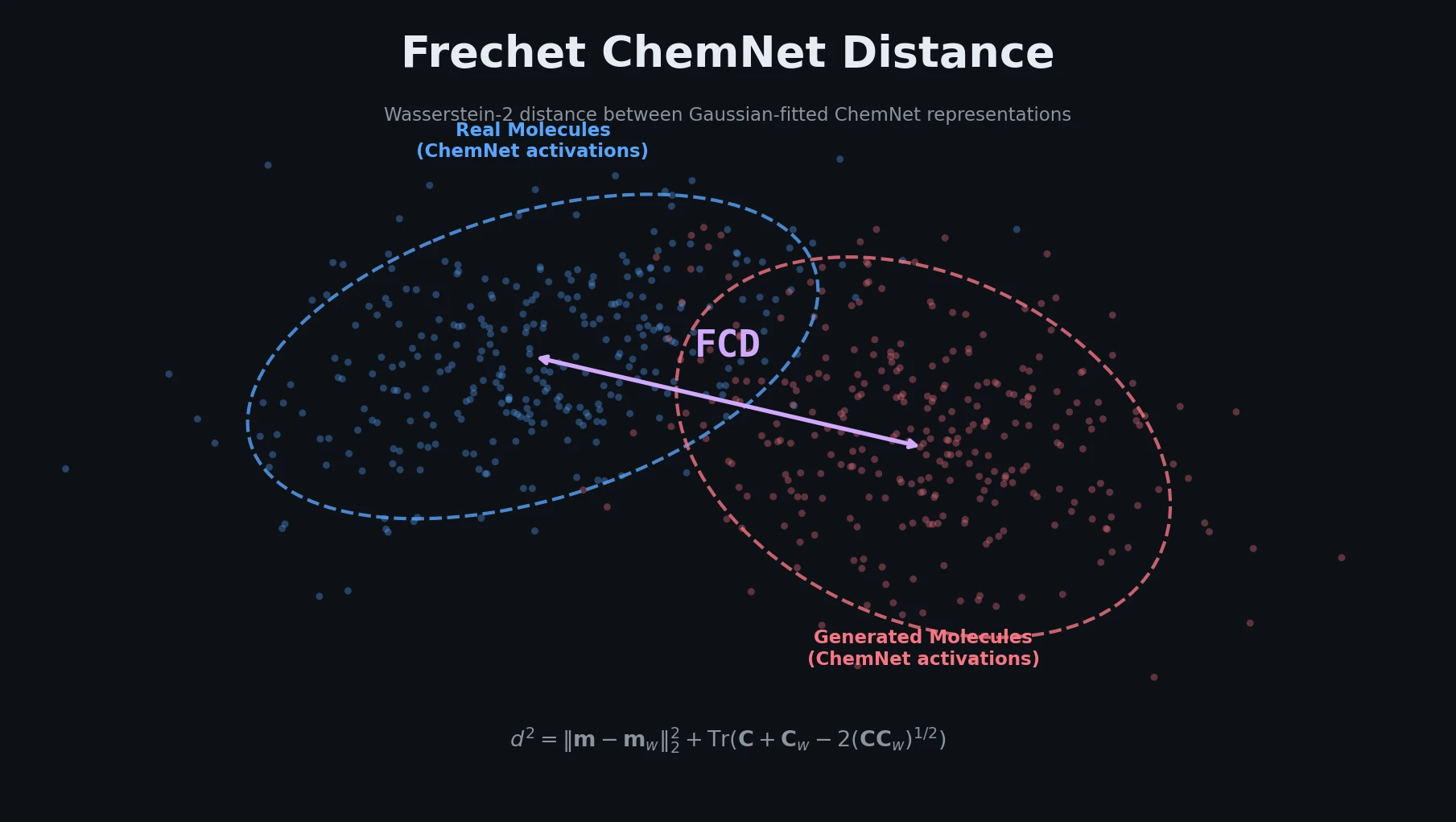
Two Gaussian distributions in ChemNet activation space with the Frechet distance shown between them

Frechet ChemNet Distance for Molecular Generation

Introduces the Frechet ChemNet Distance (FCD), a single metric that captures chemical validity, biological relevance, and diversity of generated molecules by comparing distributions of learned ChemNet representations.

Molecular Generation
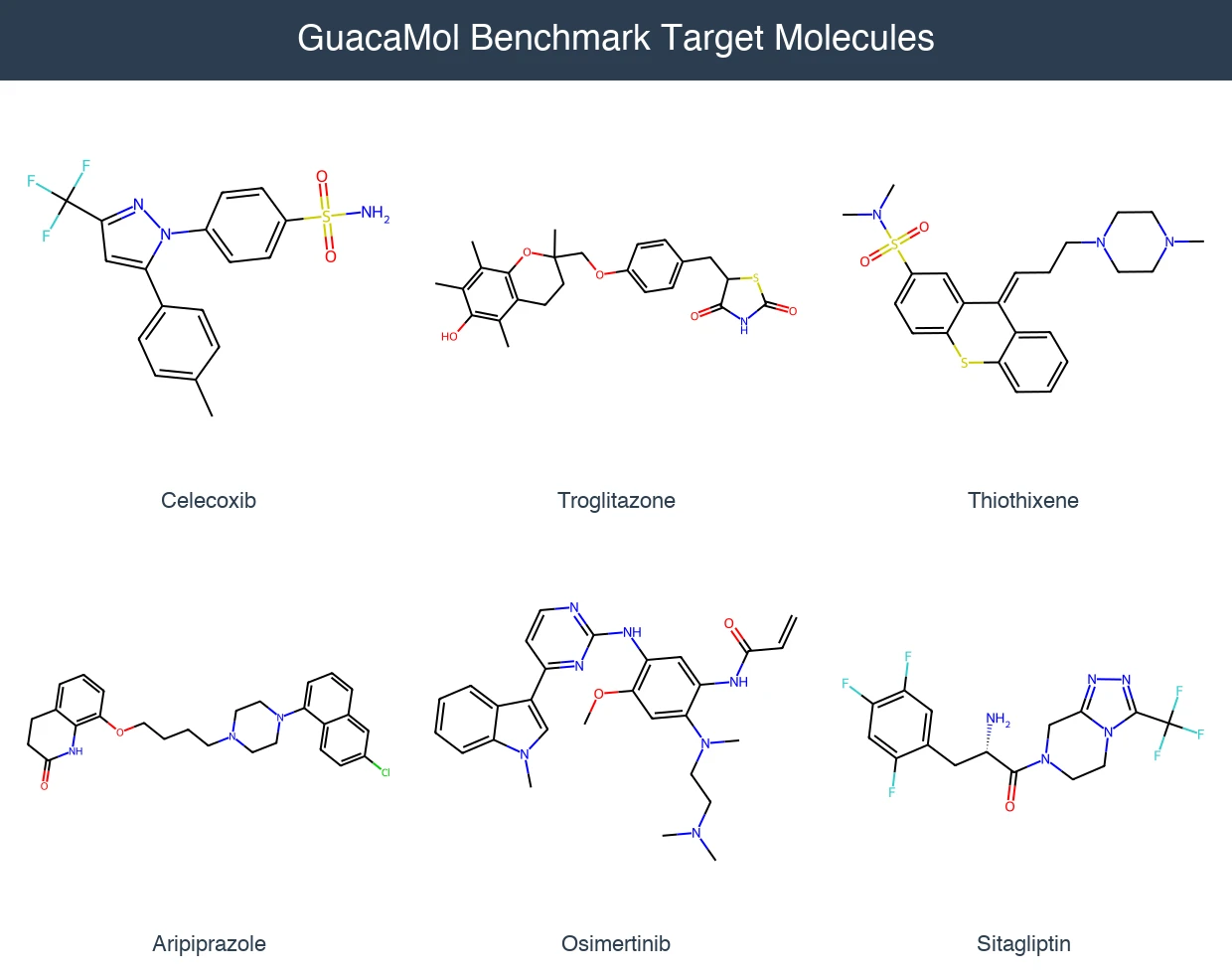
Grid of six GuacaMol benchmark target molecules: Celecoxib, Troglitazone, Thiothixene, Aripiprazole, Osimertinib, and Sitagliptin

GuacaMol: Benchmarking Models for De Novo Molecular Design

GuacaMol provides an open-source benchmarking framework with 5 distribution-learning and 20 goal-directed tasks to standardize evaluation of de novo molecular design models.