Machine Learning Fundamentals
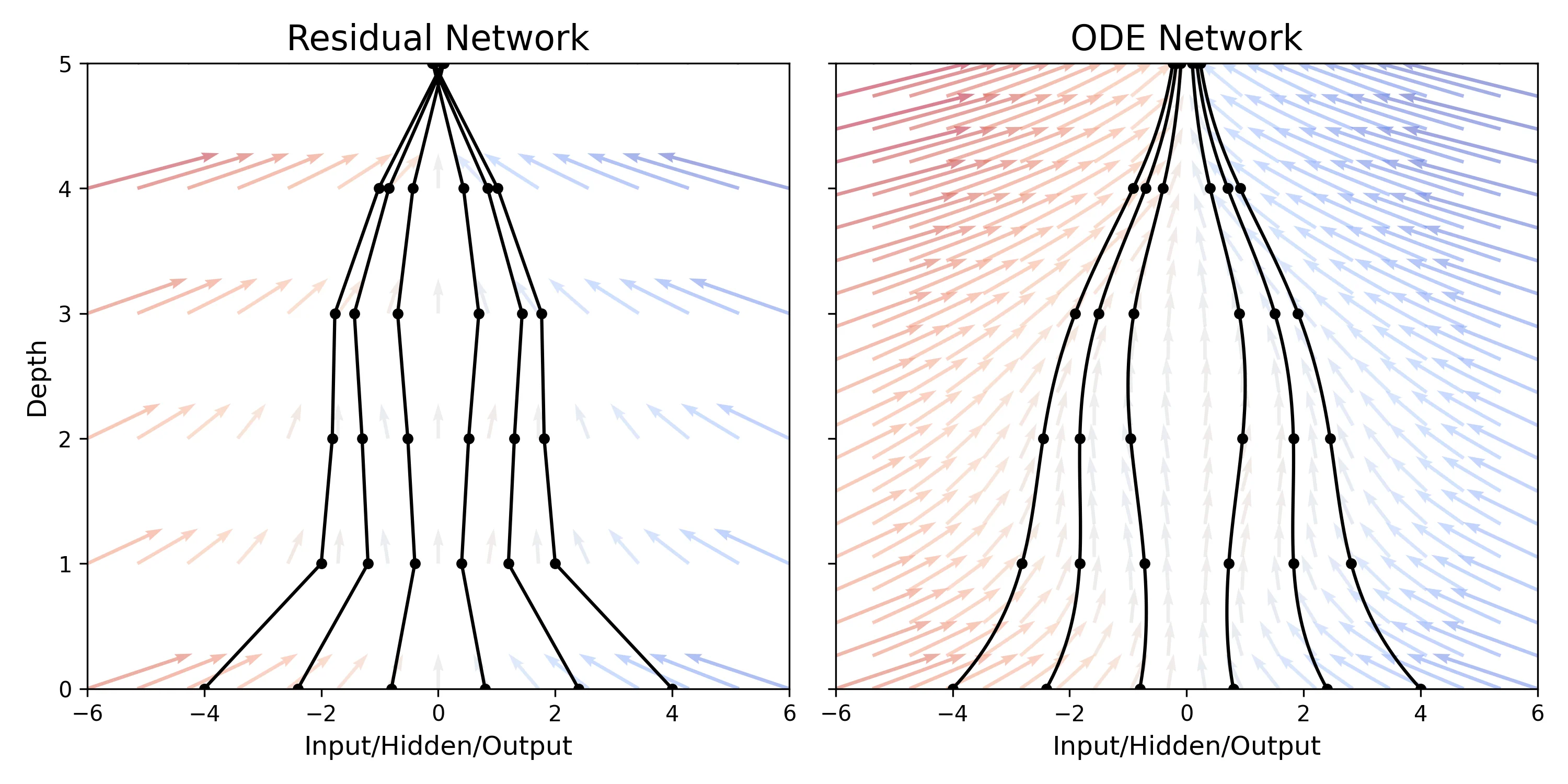
Comparison of Residual Network vs ODE Network architectures showing discrete layers versus continuous transformations

Neural ODEs: Continuous-Depth Deep Learning Models

This paper replaces discrete network layers with continuous ordinary differential equations (ODEs), allowing for adaptive computation depth and constant memory cost during training via the adjoint sensitivity method. It introduces Continuous Normalizing Flows and latent ODEs for time-series.

Computational Biology
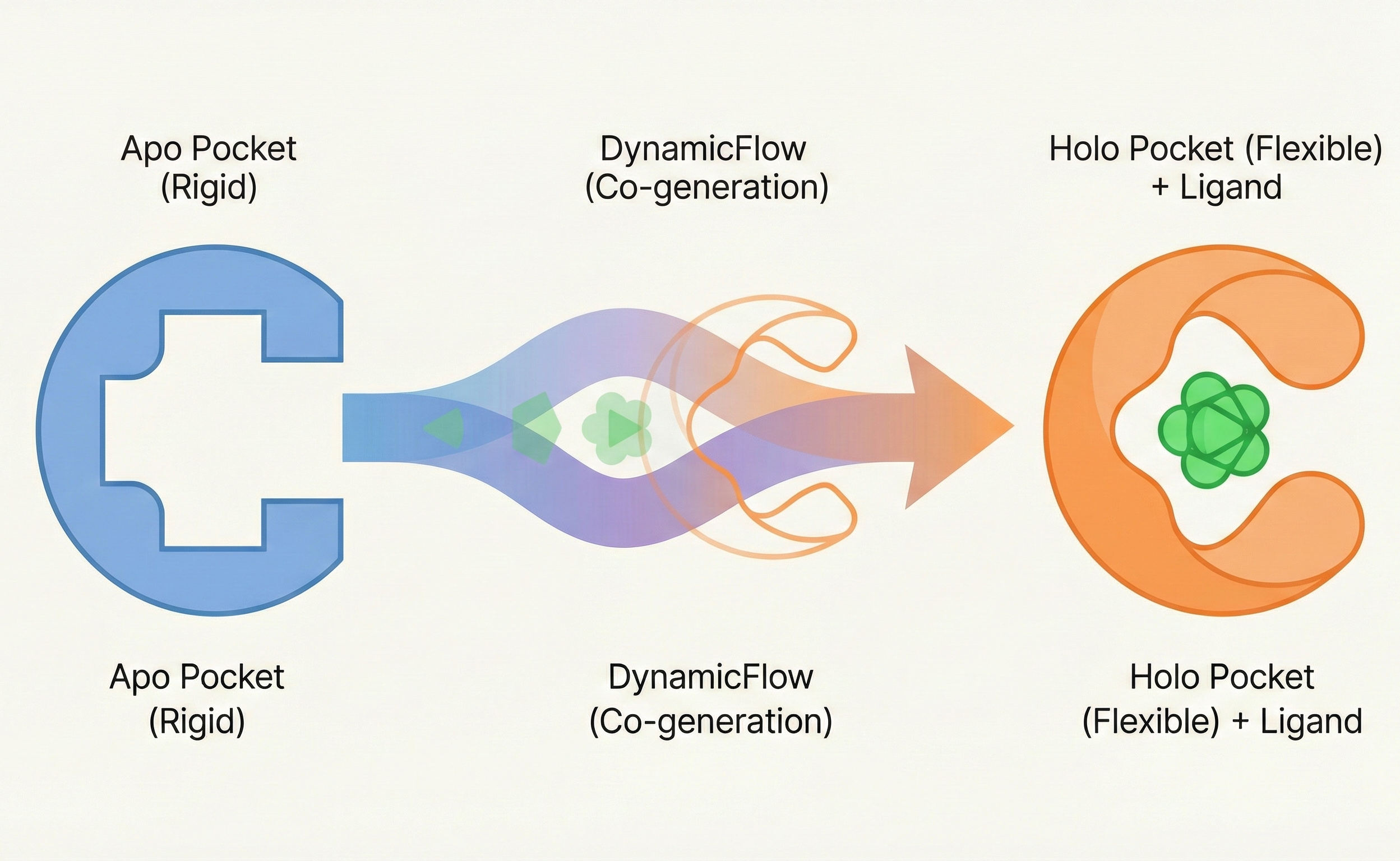
DynamicFlow illustration showing the transformation from apo pocket to holo pocket with ligand molecule generation

DynamicFlow: Integrating Protein Dynamics into Drug Design

This paper introduces DynamicFlow, a full-atom stochastic flow matching model that simultaneously generates ligand molecules and transforms protein pockets from apo to holo states. It also contributes a new dataset of MD-simulated apo-holo pairs derived from MISATO.

Computational Chemistry
MOFFlow assembles metal nodes and organic linkers into Metal-Organic Framework structures

MOFFlow: Flow Matching for MOF Structure Prediction

MOFFlow is the first deep generative model tailored for Metal-Organic Framework (MOF) structure prediction. It utilizes Riemannian flow matching on SE(3) to assemble rigid building blocks (metal nodes and organic linkers), achieving higher accuracy and scalability than atom-based methods on large systems.

Planetary Science
Orbital diagram showing chaotic planetary trajectories

Chaotic Evolution of the Solar System (Sussman 1992)

Sussman and Wisdom’s 1992 study used the Supercomputer Toolkit and symplectic mapping to integrate the entire Solar System for 100 million years, confirming chaotic behavior with an exponential divergence timescale of ~4 million years and demonstrating that long-term planetary motion is fundamentally unpredictable.

Computational Chemistry
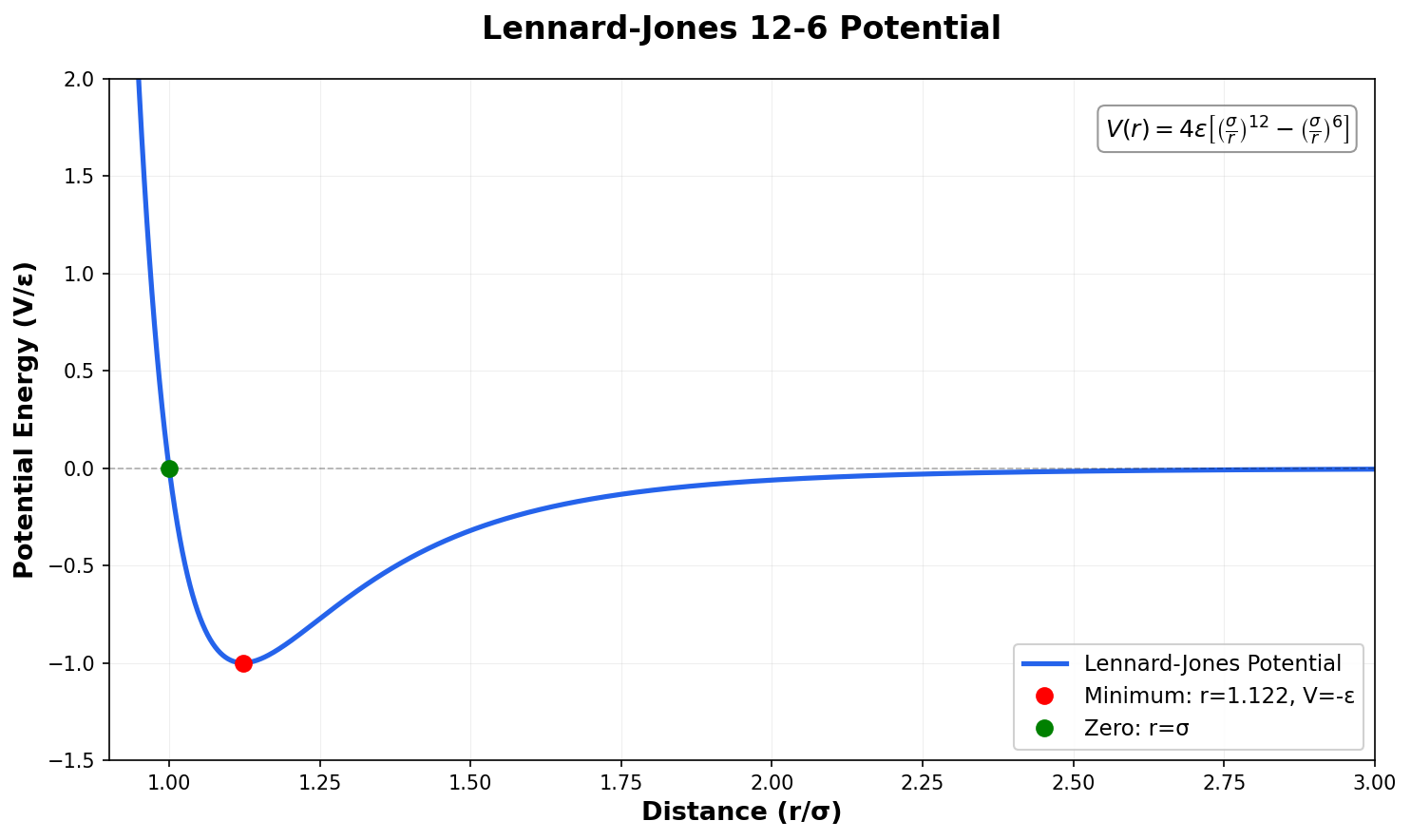
Graph of the Lennard-Jones 12-6 potential showing the characteristic attractive and repulsive forces

Dynamical Corrections to TST for Surface Diffusion

This paper bridges Molecular Dynamics and Transition State Theory by applying a dynamical corrections formalism to surface diffusion, identifying a low-temperature bounce-back mechanism causing non-Arrhenius behavior.

Computational Chemistry
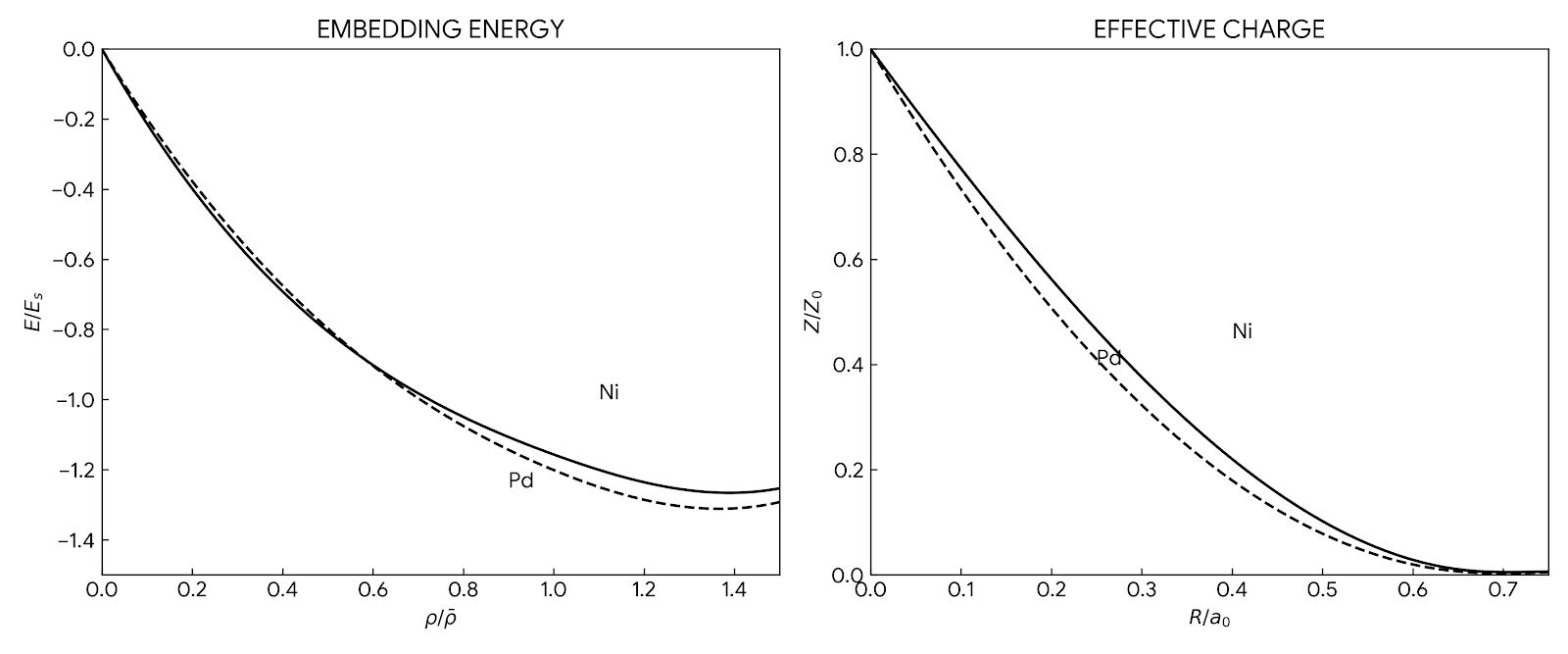
Embedding energy and effective charge functions for Ni and Pd from the original EAM paper

Embedded-Atom Method User Guide: Voter's 1994 Chapter

This 1994 handbook chapter serves as a practical user guide for the Embedded-Atom Method (EAM). It details the theoretical derivation from density-functional theory, synthesizes related methods like the Glue Model, and provides a complete tutorial on fitting potentials, illustrated with a specific implementation for the Ni-Al-B system.

Computational Chemistry
Embedding energy and effective charge functions for Ni and Pd from the original EAM paper

Embedded-Atom Method: Theory and Applications Review

This 1993 review systematizes the Embedded-Atom Method (EAM) as a practical semi-empirical approach for metallic systems. It synthesizes theory, applications, and connections to related methods while addressing the limitations of pair potentials.

Computational Chemistry
Graph of the Lennard-Jones 12-6 potential showing the characteristic attractive and repulsive forces

Evans 1986: Thermal Conductivity of Lennard-Jones Fluid

This paper validates the homogeneous Evans method for calculating thermal conductivity against experimental Argon data. It demonstrates broad agreement across the phase diagram but identifies significant non-monotonic behavior and enhanced long-time tails near the critical point.

Computational Biology
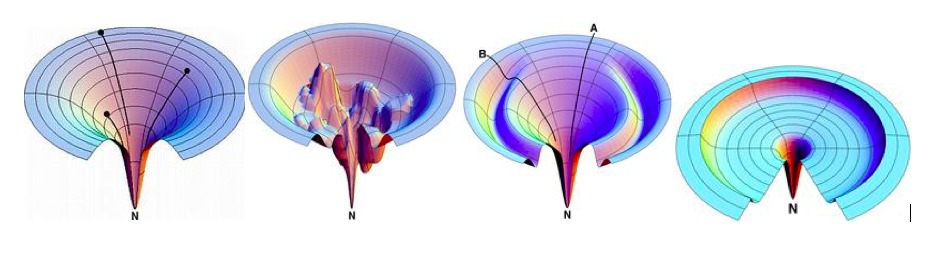
Four types of protein folding energy landscapes from left to right: smooth funnel, rugged funnel with kinetic traps, moat funnel, and champagne glass funnel

Funnels, Pathways, and Energy Landscapes of Protein Folding

This paper resolves Levinthal’s paradox by replacing the single-pathway view with a statistical energy landscape approach. It introduces the concepts of the folding funnel, the glass transition in proteins, and the ‘stability gap’ as a design principle for foldable sequences.

Computational Chemistry
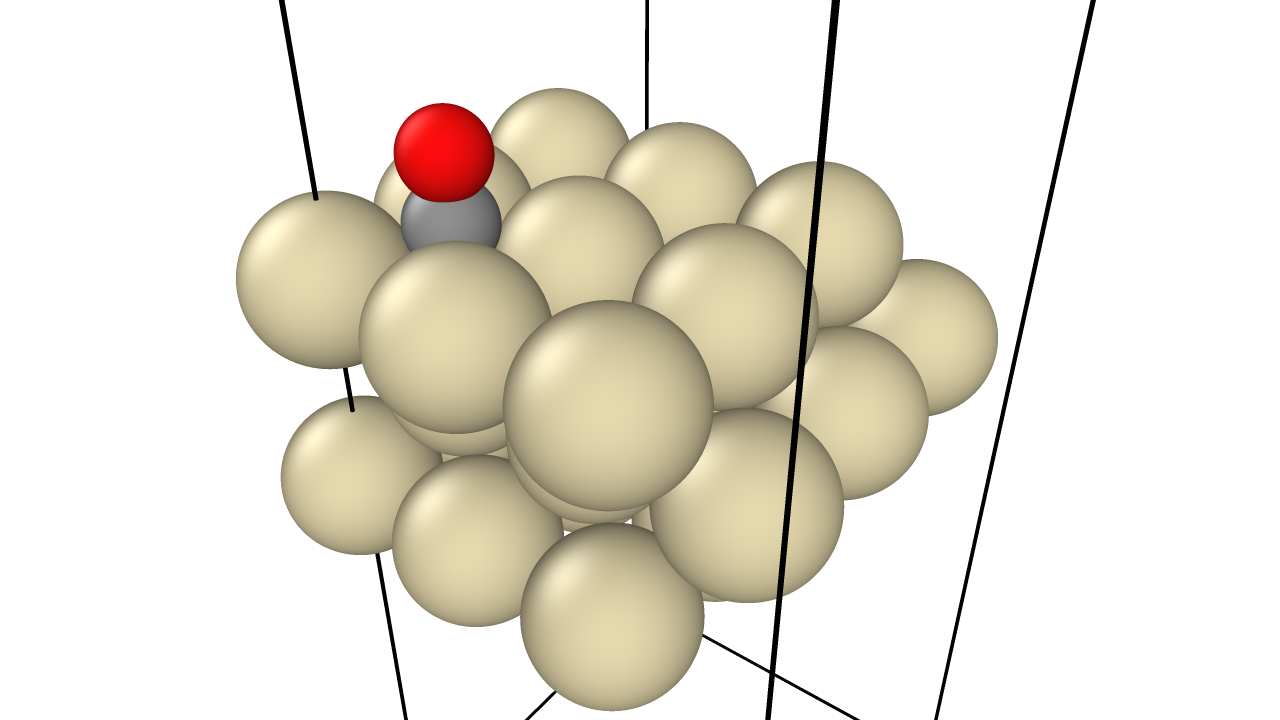
Carbon monoxide molecule adsorbed on Pt(100) FCC surface in hollow site configuration

Kinetic Oscillations in CO Oxidation on Pt(100): Theory

Imbihl et al. establish the first detailed microscopic model for CO oxidation oscillations on Pt(100), identifying the adsorbate-induced hex to 1x1 phase transition as the driving force. The study combines linear stability analysis with numerical reaction-diffusion simulations.

Computational Chemistry
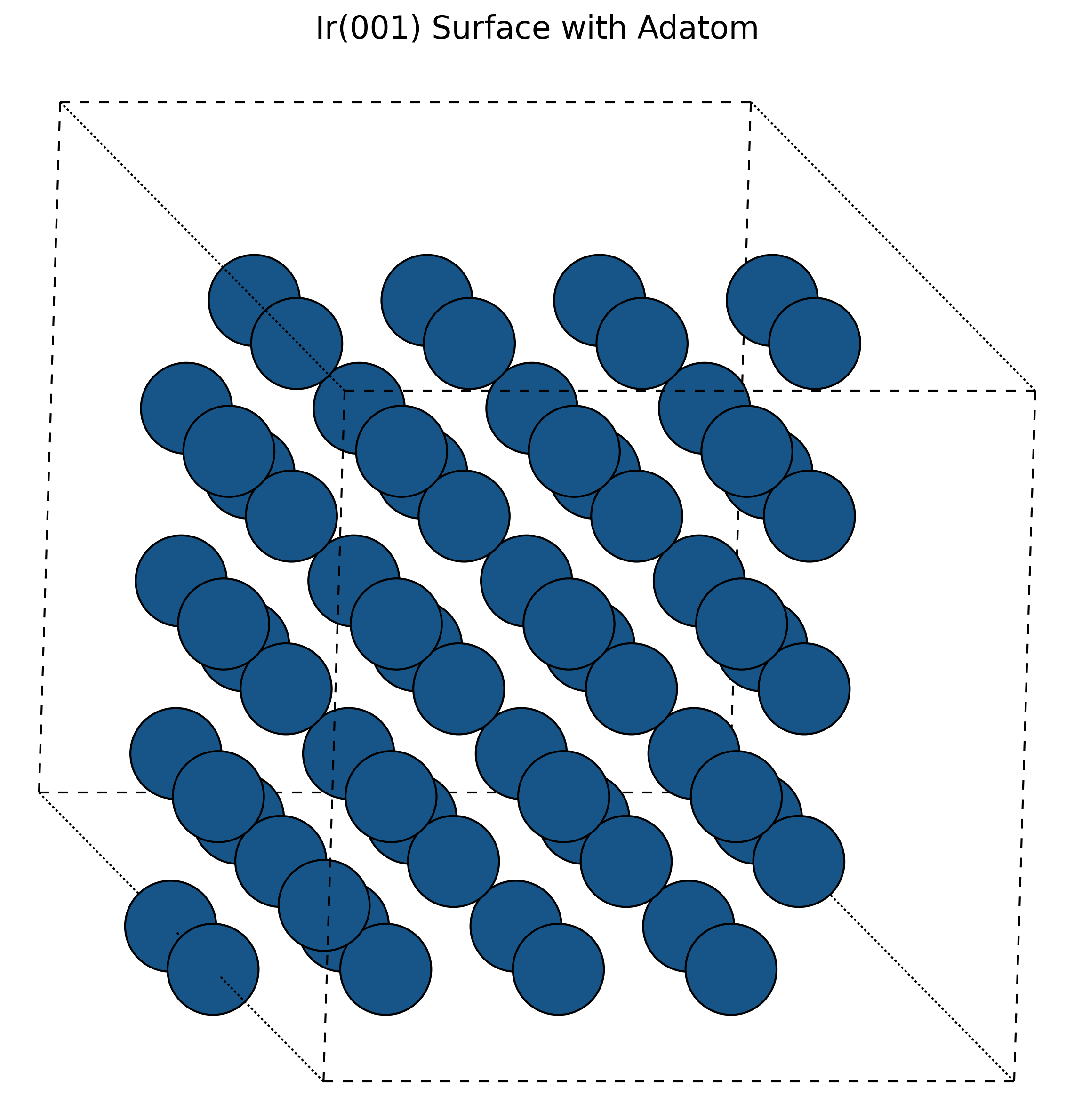
Iridium fcc(001) surface with adatom

MD Simulation of Self-Diffusion on Metal Surfaces (1994)

A molecular dynamics investigation using EAM and many-body potentials to elucidate atomic exchange mechanisms on Iridium surfaces, verifying Field Ion Microscope observations.

Computational Chemistry
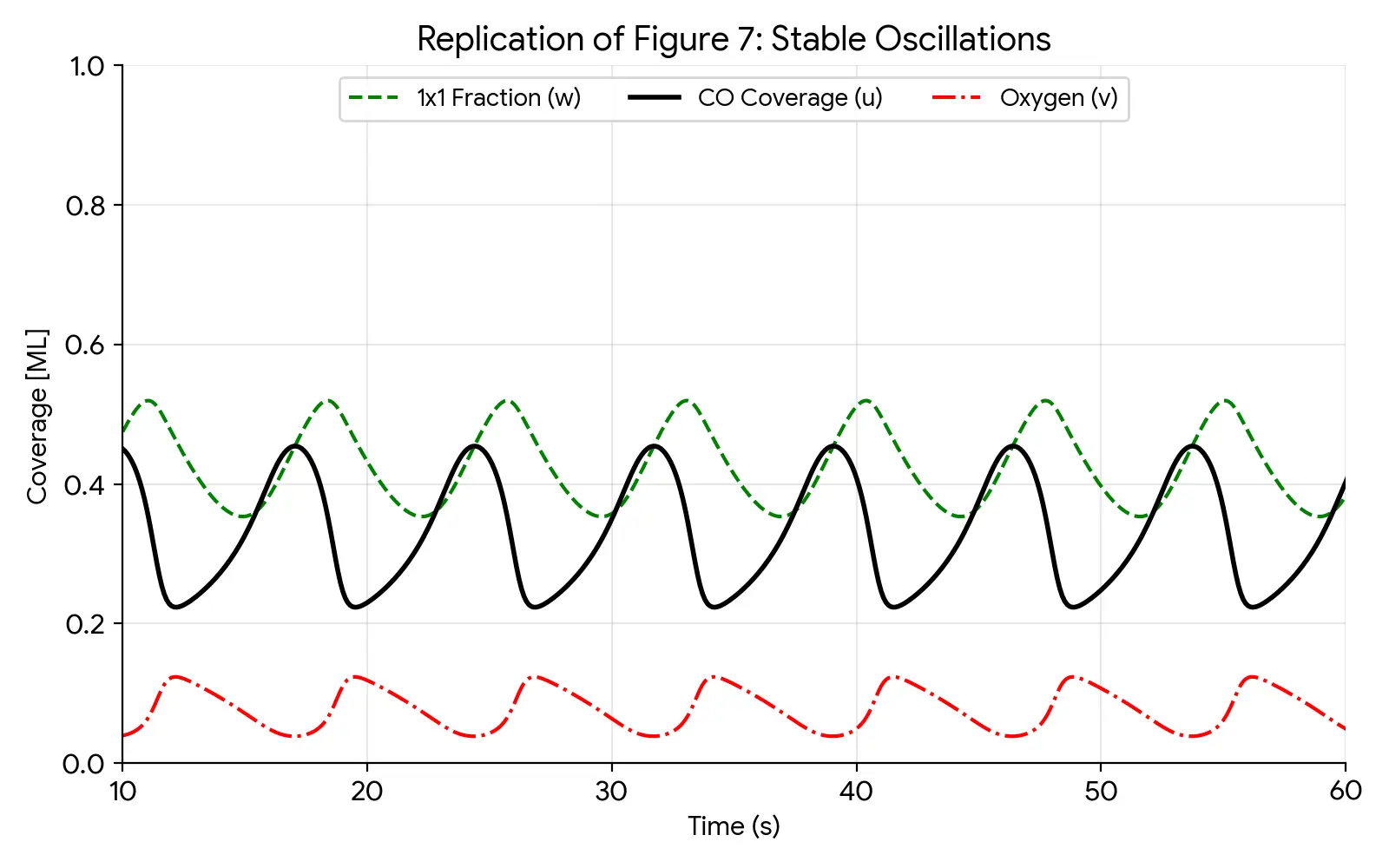
Replication of Figure 7 showing stable oscillations in CO oxidation on Pt(110)

Oscillatory CO Oxidation on Pt(110): Temporal Modeling

This paper presents a 4-variable kinetic model coupling surface reaction dynamics with structural phase transitions to reproduce complex oscillatory behavior on Pt(110).